When a Personal Bank Statement Can Support Business Expenses
Thomas Gak-Deluen9 min read
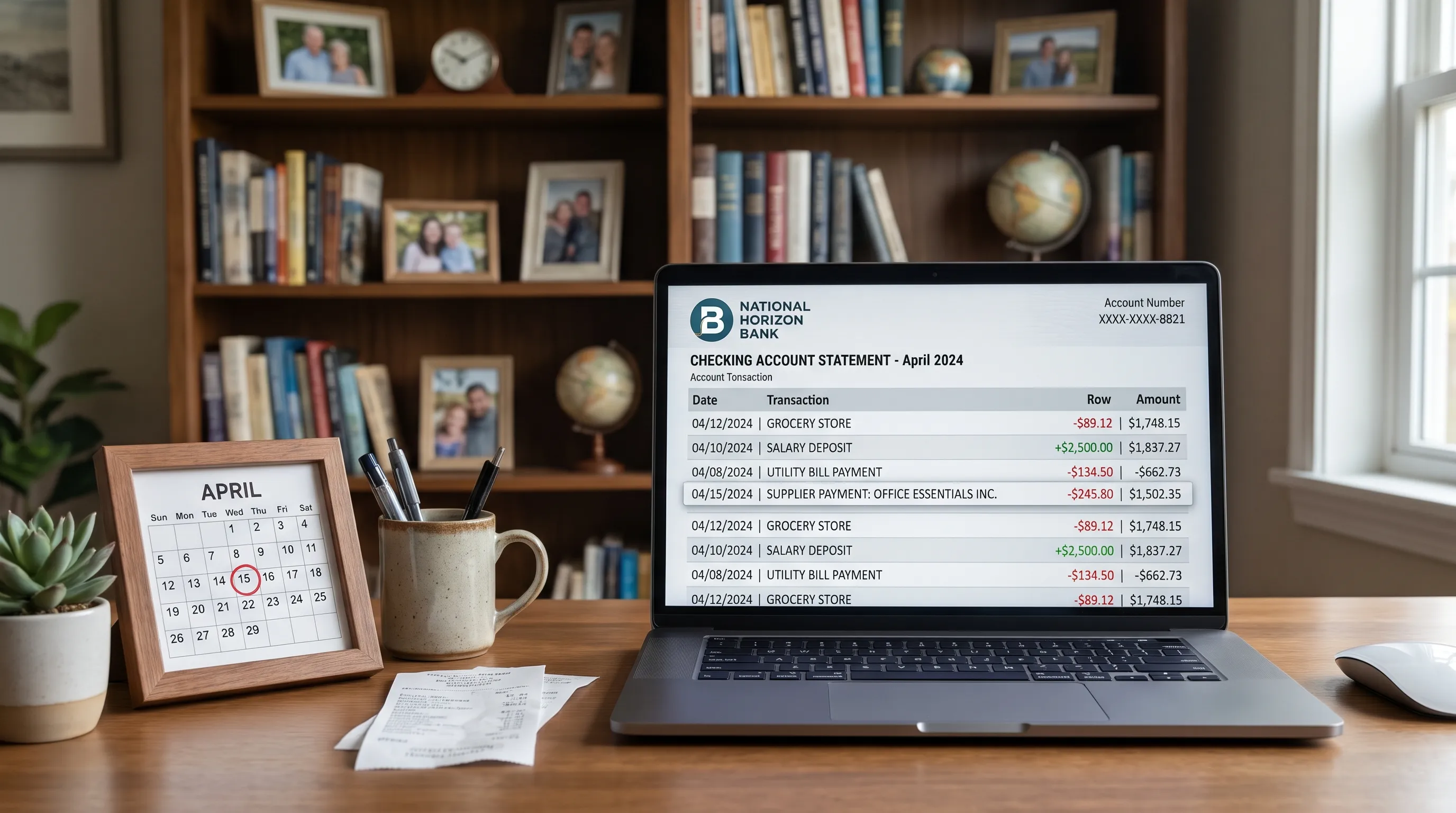
A personal bank statement can support a business expense when it connects a payment you made to a genuine business purchase. It usually cannot establish the full claim by itself. You also need evidence of what you bought, why it served the business and how much belongs in the business records.
This guide focuses on US federal tax and bookkeeping principles. Employer reimbursement policies, bank account terms and rules in other countries can impose different requirements.
What a statement proves, and what it leaves out
A bank statement records activity in an account. A posted debit can help establish the payment date, amount and recipient, although merchant descriptions may be abbreviated or identify a payment processor rather than the supplier.
What it usually does not show is the purchase detail. A $240 department-store charge could cover office supplies, household items or both. Nor does the transaction explain why the purchase was necessary for your work.
Proof of payment and evidence of business purpose are different parts of the record. Neither automatically establishes that a cost is deductible immediately. Equipment, inventory and other purchases may require different accounting or tax treatment.
The IRS guidance on business recordkeeping explains the role of supporting documents such as invoices, receipts and paid bills alongside your books.
When can a personal bank statement support a business expense?
The strongest cases have a clear connection between the transaction, purchase documentation and business activity.
| Situation | How the statement helps | Additional evidence to keep |
|---|---|---|
| You bought supplies for your sole proprietorship | Supports the amount paid from personal funds | Itemized receipt and business-use explanation |
| You paid a company bill personally | Supports your payment to the supplier | Invoice addressed to the company, approval and reimbursement record |
| One purchase included business and personal items | Confirms the total payment | Itemized receipt and allocation of the business portion |
| You paid for business travel | Supports individual charges | Itinerary, receipts and records explaining the business purpose |
| A supplier receipt is missing | Provides a starting point for reconstructing the purchase | Duplicate invoice, order history or other reliable supporting records |
A personal bank statement is useful in these situations because it documents the funding source. It does not turn a personal purchase into a business expense, override an employer's policy or authorize business use of an account whose terms prohibit it.
For recurring business spending, a separate business account makes the evidence easier to follow. An occasional payment from the wrong account is a recordkeeping issue to resolve, not a reason to include every personal transaction in the business ledger.
Build an evidence file around the payment
For each purchase, preserve enough information for someone else to understand the transaction without relying on your memory.
- Purchase detail: Keep the itemized receipt, supplier invoice or order confirmation showing what was purchased.
- Payment evidence: Identify the relevant statement transaction, including the account holder, date, amount and merchant reference.
- Business purpose: Record the project, client, work activity or operational need the purchase supported.
- Allocation: Explain any split between business and personal use, using a reasonable method supported by records.
- Approval and settlement: Retain any expense report, authorization and reimbursement confirmation.
A personal bank statement should be cross-referenced to these records, not treated as their replacement. A simple reference such as “EXP-041” can connect the receipt, transaction and bookkeeping entry.
Write the explanation while the details are fresh. “Printer paper for the consulting office” is more useful than “business expense.” For mixed-use services, preserve the basis for the business-use percentage rather than applying an unexplained estimate.
Travel, meals, gifts and vehicle expenses have additional substantiation requirements. IRS Publication 463 explains the records required and the circumstances in which documentary-evidence exceptions may apply. Do not assume that a small charge or a recognizable merchant name removes those requirements.
Record the payment according to the business structure
Sole proprietors and disregarded single-member LLCs
For a sole proprietor, paying from a personal account does not by itself determine whether a purchase is a business expense. Its nature, business use and supporting evidence matter.
In business-only books, a personally funded purchase is commonly recorded as the relevant expense or asset, with an offset to an owner contribution or owner-paid clearing account. The exact entry depends on the bookkeeping setup. A single-member LLC that has elected corporate tax treatment needs a different analysis.
Keep the personal bank statement as supporting evidence without importing unrelated household spending into the business accounts.
Corporations, partnerships and employee reimbursements
When an owner or employee pays a company's bill, document both the supplier purchase and the company's obligation to reimburse that person. A typical workflow records the expense or asset and an amount payable to the person who funded it. Reimbursement then clears that payable rather than creating another expense.
Employee reimbursements may qualify for exclusion from wages under an accountable plan when the applicable business-connection, substantiation and return-of-excess requirements are met. Merely labeling a transfer “reimbursement” is not enough.
For shareholders and partners, ask the accountant how the payment should be classified. Agreements, reimbursement policies and entity-specific rules can affect whether it belongs in a payable, contribution, loan or another account.
Worked example: one charge, only part business
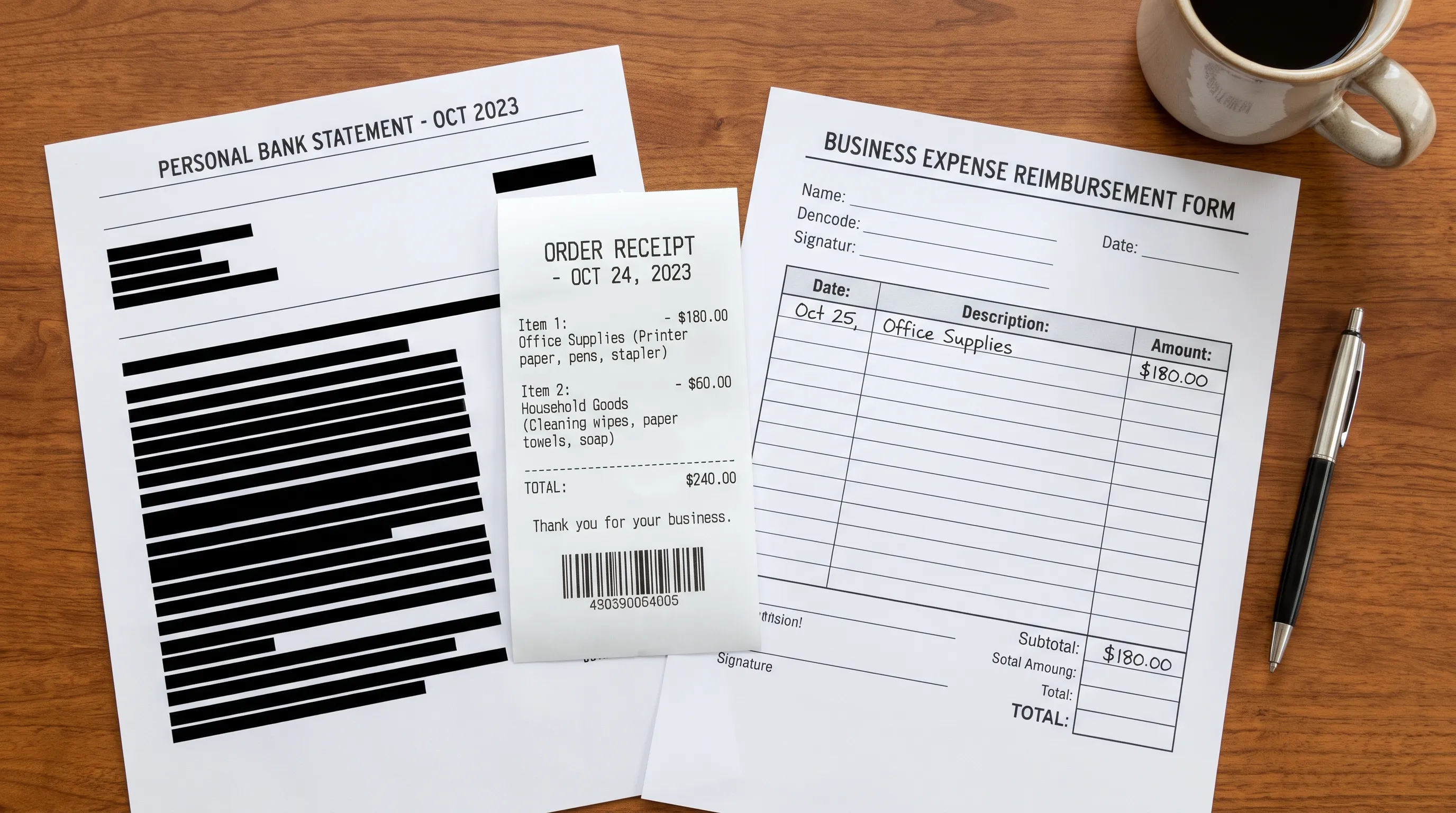
Suppose you pay $240 from your own checking account for an order containing $180 of office supplies and $60 of household goods. Assume the office supplies are properly treated as a current business expense.
Your personal bank statement shows the $240 payment. The itemized receipt identifies the $180 business portion, and your expense report explains that the supplies were purchased for the company office.
The company's records should reflect the supported $180 expense, not the full $240 debit. If the company owes you reimbursement, it records the corresponding $180 payable. When the company transfers $180 to you, that payment clears the payable. It is not a second office-supply expense.
The same principle prevents credit card duplication. If individual card purchases have already been recorded, paying the card bill is generally a settlement of the card balance, not another purchase expense.
Also check for returns and credits. If the supplier later refunds part of the business purchase, connect that refund to the original record and adjust the expense and any unsettled reimbursement accordingly.
Share enough evidence without exposing your finances
An expense reviewer may need the relevant transaction, account holder's name and statement period. They may not need to see your rent, medical payments or unrelated account activity.
Before sharing a personal bank statement, ask the recipient what they require and whether they accept a redacted copy or transaction-specific bank record. Do not assume an employer, auditor or tax authority will accept the same format.
Keep the original bank-issued file unchanged. Create a separate sharing copy and use a redaction method that actually removes information, rather than placing removable boxes over text. Preserve the details needed to connect the payment to the claim, and label the copy as redacted.
Send sensitive documents through an approved secure channel. If the statement concerns a joint account, consider the other account holder's privacy as well.
For larger or disputed claims, follow a consistent process for checking a statement's source and authenticity. Matching arithmetic does not prove that a document came from a bank or that its underlying transactions were legitimate.
If the business disputes reimbursement
A personal bank statement can help show that you paid a supplier, but it may not establish that the business agreed to repay you. Keep purchase approvals, correspondence, contracts and the expense policy in force when you incurred the cost.
Start by identifying whether the disagreement concerns payment, authorization or business purpose. Each requires different evidence.
For a dispute involving a Dutch business, local legal advice may be appropriate. Janssen Van den Biezenbos Advocaten in Eindhoven lists civil disputes among its practice areas; confirm whether the firm can assist with the particular reimbursement issue. Legal entitlement to repayment and tax treatment are separate questions.
Convert transaction data without losing the evidence trail
A spreadsheet can make personally paid expenses easier to review, especially when several months of statements are involved. Keep the original PDFs alongside the extracted data so each spreadsheet row remains traceable to its source.
First check that the statement covers the right account and period and includes all pages. Then validate the extracted amounts against the running balances and declared totals. Classify business transactions only after that numerical check, adding receipt references, business-use amounts and reimbursement status in separate columns.
When extracting a personal bank statement, keep the statement's original transaction amount distinct from the amount claimed. In the worked example, those values are $240 and $180. Replacing the original figure with the business portion would break the connection to the bank record.
The same distinction matters for foreign-currency purchases. Preserve the supplier's invoice currency and the amount actually charged to the account, then document the conversion basis used in the books.
For broader reconciliation controls, use these business bank statement checks alongside the supporting receipts and reimbursement records.
Frequently asked questions
Can I claim a business expense paid from my personal account? Potentially, yes. The payment account alone does not determine eligibility. You still need a qualifying business cost, adequate supporting records and the correct treatment for your business structure. Employer policies may impose additional reimbursement requirements.
Is a bank statement enough if I lost the receipt? Do not assume it is. Ask the supplier for a duplicate receipt or retrieve the invoice from your order history. Preserve other reliable evidence and document the business purpose. Specific substantiation rules and exceptions depend on the expense category.
Does reimbursement make an expense deductible? No. A transfer back to you does not establish business purpose or deductibility. The underlying purchase must qualify, and the reimbursement must be recorded correctly. Personal costs do not become business expenses because a company pays them.
How long should I keep the statement and receipts? Retain them for the applicable tax recordkeeping period, considering the return, transaction and any longer requirements. Asset records, employment records and documents connected to disputes may need different retention periods. Keep the linked evidence together rather than retaining only the spreadsheet.
Prepare reliable records before reimbursement
A personal bank statement is most useful when it forms part of a clear evidence trail: purchase detail, business purpose, payment, accounting entry and any reimbursement.
Extract Bank Statements converts statement PDFs to CSV, Excel, OFX or JSON and checks extracted figures against the statement's running balance and declared totals. OCR supports scans and photos, and free first conversions let you try the workflow.
Those checks help establish numerical consistency. They do not determine deductibility, prove document authenticity or replace receipts. Use the verified transaction data as the foundation for your expense review, then attach the evidence that explains the business claim.