
Business Bank Statement Checks Every Finance Team Should Use
Thomas Gak-Deluen9 min read
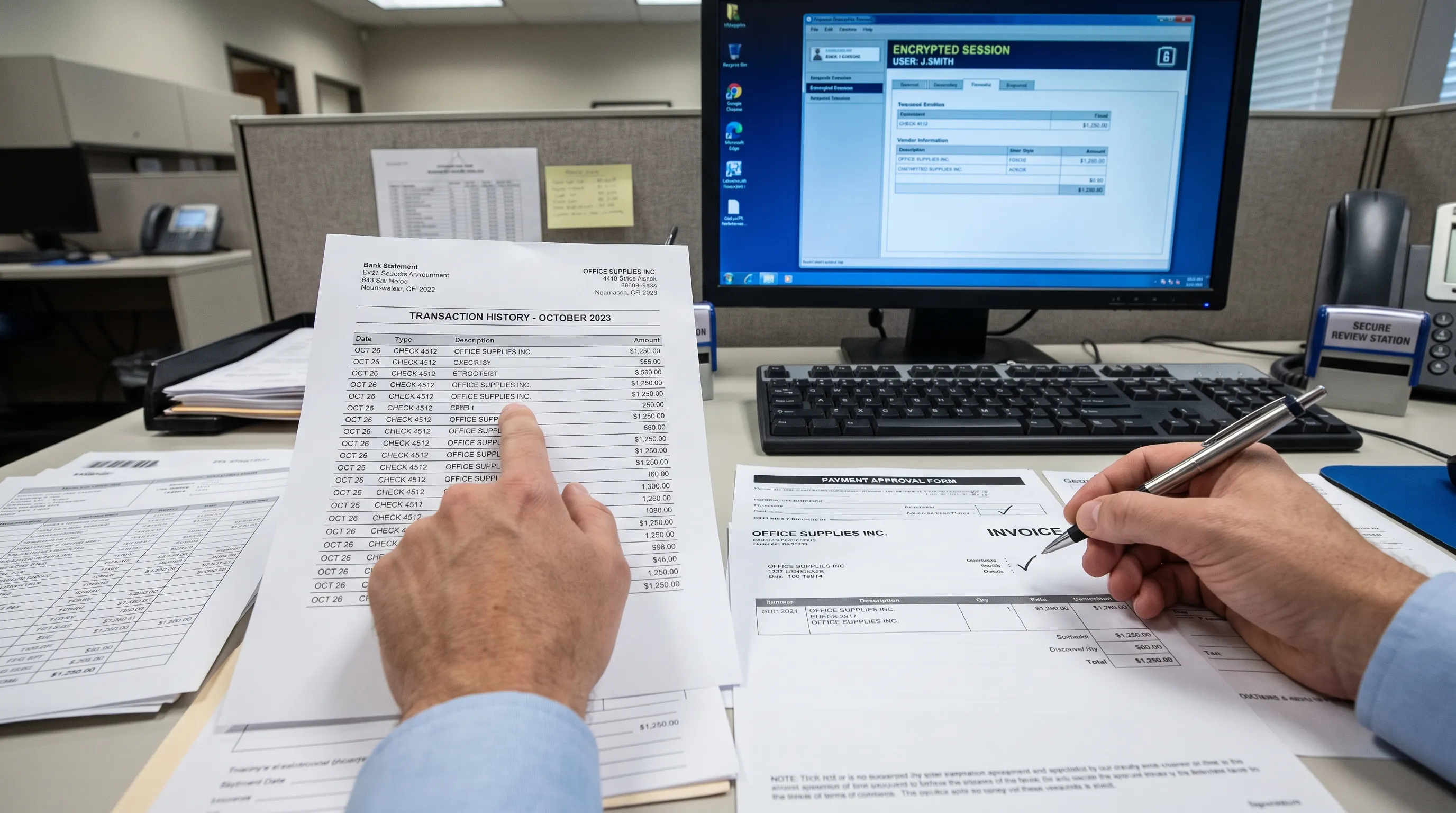
A business bank statement should enter the month-end close as a controlled source document, not just a PDF someone downloaded. Before its figures feed cash reporting, expense analysis or accounting imports, the finance team needs to establish that the file is complete, the extracted numbers are accurate and the transactions reconcile to the books. Those are separate checks, and passing one does not mean the others have passed.
The following workflow turns statement review into a repeatable control with clear ownership, documented exceptions and evidence a reviewer can follow.
Separate data accuracy, reconciliation and authorization
A useful review answers three different questions.
Does the data match the statement? Dates, amounts, transaction descriptions and balances must survive extraction without missing rows, shifted columns or changed signs.
Does bank cash reconcile to the general ledger? Differences must be explained by supported timing items, missing entries or errors, rather than hidden inside a balancing adjustment.
Were the transactions legitimate and recorded correctly? A payment can appear accurately on the statement and reconcile perfectly while still being unauthorized, duplicated or charged to the wrong expense account.
Assign a preparer and reviewer for each account. The preparer performs the checks and documents exceptions. The reviewer challenges unresolved items and confirms that the evidence supports the conclusion. Where staffing permits, neither should be the person who initiated the payments being reviewed.
A business bank statement is evidence of activity recorded by the bank, not proof that every payment had business approval. The distinction matters when someone treats a successful balance check as permission to skip transaction review. Our explanation of what statement reconciliation proves and what it does not explores that boundary.
Confirm account coverage and the reporting cutoff
Start from the organization's account register, not from whatever PDFs arrived in the shared folder. Include operating accounts, payroll accounts, savings accounts and foreign-currency accounts, including accounts with little activity. Handle credit card statements separately because their balance conventions differ from deposit accounts.
For each account, verify the legal entity, account identifier, currency, statement period and page count. Obtain the statement through an approved banking channel where possible. Keep the original file rather than relying only on a spreadsheet supplied by another department.
Compare the opening balance with the prior statement's closing balance. A mismatch requires an explanation, such as an omitted statement or a revised document. Also check that consecutive periods have neither gaps nor unintended overlap.
The reporting date needs special attention. If the statement ends before month-end, obtain supported activity through the close date. If it spans beyond month-end, isolate the relevant period without losing the surrounding reconciliation evidence. Use posting dates consistently for bank reconciliation and preserve other dates when they explain settlement timing.
Validate business bank statement data before importing it
The extraction control should test individual rows and the statement as a whole. For a deposit account, using signed balances and positive amounts for credits and debits:
Opening balance + credits − debits = closing balance.
Where running balances appear, test each transition as well. A dropped withdrawal may cause the next balance to fail even when the remaining rows look plausible.
When converting a business bank statement, compare extracted credit and debit totals with any totals declared by the bank. Inspect representative rows against the PDF, especially page boundaries, multiline descriptions, negative amounts and transactions near the reporting cutoff. Avoid assuming that a spreadsheet formula proves the source was captured correctly.
Scanned documents add recognition risks: a decimal separator can disappear, a digit can be misread or an amount can land in the wrong column. Rescan unreadable pages or verify them manually rather than accepting ambiguous figures. This guide to handling blurry statement scans with OCR explains the underlying issues.
Keep the original statement and the version of the extracted file actually used. If data is corrected, record the change and its reason. Do not silently overwrite the only copy of the import file.
Reconcile bank cash to the ledger without using plugs
Statement arithmetic and ledger reconciliation are different controls. After validating the extraction, compare the bank's closing balance with the corresponding cash account in the general ledger at the same cutoff.
Separate differences into supported timing items and items requiring book entries. Outstanding payments and deposits in transit may explain timing. Bank fees, interest and returned payments may require entries if the books do not already contain them. Investigate bank errors separately rather than treating them as ordinary expenses.
The following hypothetical example illustrates the distinction:
| Reconciliation component | Amount |
|---|---|
| Bank statement closing balance | $36,500 |
| Add supported deposit in transit | $2,400 |
| Subtract supported outstanding payments | $3,000 |
| Adjusted bank balance | $35,900 |
| General ledger cash balance before corrections | $35,800 |
| Add interest not yet recorded | $200 |
| Subtract bank fee not yet recorded | $100 |
| Corrected ledger balance | $35,900 |
In this example, the business bank statement and corrected ledger reconcile to $35,900. The timing items do not require new entries if they are already recorded correctly in the books; the missing interest and fee do.
Every reconciling item needs a date, explanation and supporting record. Assign an owner to unresolved differences and review their age at each close. A payment that remains outstanding for several periods deserves investigation, not automatic carryforward. Never post an unexplained adjustment solely to make the reconciliation equal zero.
Review transactions by risk, not just by size
A full ledger match does not replace transaction review. Combine your organization's approval thresholds with checks for unusual behavior. Small unauthorized payments or recurring errors may matter even when they fall below a monetary threshold.
Useful exception categories include:
- Possible duplicates: Repeated amounts, references or counterparties, checked against invoices and payment records before concluding that a duplicate occurred.
- Unfamiliar recipients: New payees, changed bank details or descriptions that do not match approved vendor records.
- Unusual timing or patterns: Unexpected payment frequency, rapid reversals or amounts split into several payments that together warrant review.
- Unexpected charges: Fees, returned payments or debits inconsistent with known account activity.
Bank descriptions can be abbreviated or identify a payment processor rather than the underlying merchant. Resolve uncertainty with payment confirmations, invoices and approval records instead of guessing from the description alone.
For each exception, record the reviewer, investigation result and disposition. A business bank statement review should distinguish confirmed errors from legitimate transactions that merely looked unusual. That distinction prevents both missed problems and unnecessary corrective entries.
If a debit appears unauthorized, contact the bank promptly and follow its dispute process. Do not assume that business accounts have the same protections or notification deadlines as consumer accounts.

Check settlements, transfers and foreign currency separately
Some cash movements are easy to reconcile mathematically but easy to misclassify economically. Give these flows their own review rather than forcing them through ordinary expense matching.
Net merchant settlements
A processor deposit may combine gross sales, refunds, processing fees and other adjustments. Match the deposit to the processor's settlement report, then confirm how those components were recorded. Posting the entire deposit as revenue can conceal fees or omit refunds even though the bank amount matches.
Transfers between accounts and entities
Match both sides of an internal transfer and investigate timing differences. Within one entity, moving cash between bank accounts is not revenue or expense. Transfers between separate entities need the appropriate intercompany treatment and supporting records.
A business bank statement may show only one side of the movement, so a matching amount alone is not enough. Confirm the receiving account, entity, currency and reference before clearing the exception.
Foreign-currency activity
Reconcile each bank account in its statement currency before applying reporting-currency translation. Separate actual bank fees and conversion charges from accounting exchange differences. Preserve the source currency alongside converted amounts so reviewers can trace the reported cash figure back to the bank record.
Connect cleared spending to defensible management reporting
Bank cash confirms that money moved, but management reports need more context. Match material spending to invoices, purchase orders, cost centers and approval evidence. Review coding changes before those amounts feed departmental budgets or performance dashboards.
Marketing illustrates the difference between payment evidence and performance evidence. A campaign payment can be valid and correctly categorized without proving that the campaign generated incremental sales. DirectMail.io's guide to direct mail attribution dashboards finance teams can defend connects campaign reporting with ledger reconciliation, defined attribution windows and holdout testing.
Apply that distinction across departments: first establish the spending recorded in the books, then assess the operational claim using the relevant evidence. Do not use a cleared payment as a substitute for proof of delivery, customer acquisition or return on investment.
The business bank statement is the cash evidence in this chain. The general ledger, supporting documents and operational records explain what that cash movement represents.
Make the review repeatable with owners and completion criteria
The close checklist should define what constitutes completion. “Statement checked” is too vague to show whether someone validated the extraction, resolved reconciling items or reviewed unusual payments.
A practical control record can use the following structure:
| Control | Responsible role | Evidence retained |
|---|---|---|
| Account and period coverage | Close preparer | Account register and original statement |
| Extraction accuracy | Preparer or data operator | Export, balance tests and documented corrections |
| Ledger reconciliation | Accountant | Reconciliation and supported adjustments |
| Transaction exception review | Reviewer independent of payment initiation where feasible | Approval records and exception dispositions |
| Final close approval | Controller or designated reviewer | Sign-off and unresolved-item assessment |
Define review depth and thresholds according to the account's activity and risk. High-volume payment accounts may need automated matching plus targeted investigation; a low-activity reserve account may need a simpler review. Neither should disappear from the close checklist.
Maintain an exception log showing the account, item date, amount, issue, owner and resolution deadline. If an item remains unresolved at close, document its potential effect and the authorized decision about how to proceed.
Retain evidence under the organization's approved retention and access policies. Statements contain sensitive financial information, so restrict access to people who need it.
Frequently asked questions
Does a business bank statement that balances prove the payments were legitimate? No. It supports arithmetic consistency within the statement. Authorization, business purpose and accounting classification require separate evidence, and offsetting extraction errors can sometimes leave totals unchanged.
How often should finance teams perform these checks? Perform a documented reconciliation at each accounting close. High-volume or higher-risk accounts may also need more frequent transaction review so errors or suspicious payments are identified before month-end.
Can scanned statements be used for reconciliation? Yes, if they are complete and legible and the extracted data is verified against the source. OCR output should receive balance checks and targeted visual review, especially where characters or transaction boundaries are unclear.
What if a small team cannot fully separate duties? Use a compensating review by an owner, controller or other authorized person who did not initiate the payments. Give that reviewer the bank statement and supporting records, not only the preparer's summary. Document the staffing limitation and the review performed.
Start with verified data, then complete the accounting controls
When a business bank statement arrives as a PDF, reliable extraction removes a major source of manual rekeying risk. Extract Bank Statements converts PDFs into CSV, Excel, OFX or JSON and verifies figures against the statement's running balances and totals before export. It also supports scans and photos with OCR.
Use the verified export as the input to your reconciliation and exception-review process, not as a replacement for it. Start with the free first conversions, then retain the source statement, reconciliation and review evidence together.