What Is an Account Statement, and Which Types Can You Request?
Thomas Gak-Deluen9 min read
An account statement is a document that summarizes activity and balances for a particular account over a defined period. It may come from a bank, credit card issuer, lender, investment firm or business that extends credit to customers. The right type depends on what you need to prove: available funds, payments made, debt owed or outstanding invoices. Before requesting one, identify both the account involved and the document your recipient will accept.
What information does it usually contain?
Most statements identify the issuer, the account holder and the reporting period. They then show activity during that period and the balance at its end. Depending on the account, the document may include:
- An account number, often partly masked
- Opening and closing balances
- Dated transactions with descriptions and amounts
- Interest, fees, adjustments or refunds
- Payment deadlines or amounts due
Not every issuer uses the same layout. A checking statement might display a running balance after each transaction, while a credit card statement emphasizes the statement balance, minimum payment and due date. A supplier’s statement may organize unpaid invoices by age rather than list every purchase made during the month.
An account statement describes the position recorded by its issuer, so its figures should be checked against your own records when accuracy matters. It is useful evidence, but it does not automatically explain the purpose or legitimacy of every transaction.
Which types of account statement can you request?
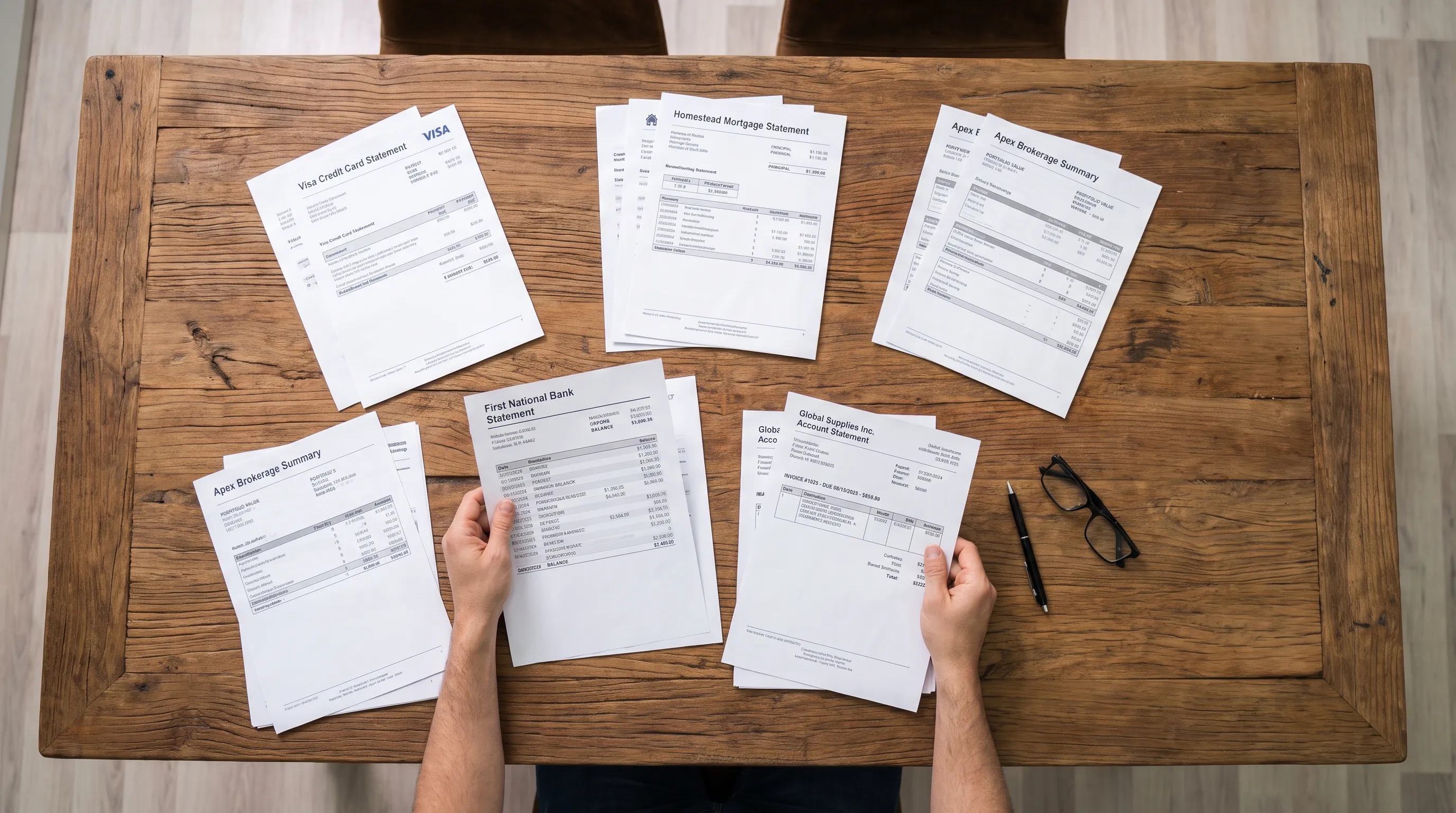
The term covers several distinct documents. These are the main types and the situations in which they are useful.
| Type | What it typically shows | When to request it |
|---|---|---|
| Checking or savings statement | Deposits, withdrawals, transfers, fees and balances | Reviewing cash activity, bookkeeping or proving funds over a period |
| Credit card statement | Purchases, payments, credits, interest, fees and payment requirements | Checking charges or confirming the amount due for a billing cycle |
| Loan or mortgage statement | Payments, outstanding principal, interest and applicable charges | Reviewing debt payments or monitoring a loan balance |
| Brokerage or investment statement | Holdings, transactions, cash balances and investment values | Reviewing investments or documenting assets |
| Customer or supplier statement | Invoices, credit notes, payments and outstanding amounts | Reconciling a trade account or following up on unpaid invoices |
| Utility or service statement | Usage or service charges, payments and the amount owed | Reviewing recurring charges or documenting an address where accepted |
Availability and frequency vary by provider. Some documents are produced monthly, while others are quarterly or available on request.
A customer statement is particularly easy to confuse with an invoice. An invoice requests payment for a specific sale or service; a statement summarizes the wider account position, potentially covering several invoices and payments.
Choose the account statement that matches the underlying question rather than assuming a bank document will satisfy every request.
Is a statement the same as a transaction history?
An official statement is issued for a defined period and normally includes identifying details, balances and the issuer’s presentation of account activity. A transaction history is an activity list that may cover a date range you choose. It can be useful for searching payments, but it may omit opening balances, account-holder details or other information a recipient requires.
A screenshot is more limited still. It may show a current balance without establishing who owns the account, whether transactions are pending or what happened during the rest of the period.
Other documents serve different purposes. A balance confirmation reports a balance as of a specified date. A payment receipt records an individual transaction. Neither necessarily provides a complete period of activity.
If a lender, landlord or accountant asks for an account statement, confirm whether they require the issuer’s original PDF, all pages and a particular reporting period. A spreadsheet export or screenshot may not be an acceptable substitute, even when the numbers are accurate.
How to request the right document
Download it through the provider’s website or app
Sign in through the provider’s official website or app and look for a section such as Statements, Documents or Account services. Select the correct account and reporting period, then download the available document. Menu names and download options vary.
For formal submissions, the original PDF is usually the best starting point because it preserves the issuer’s layout and period information. Keep that file unchanged, even if you also create a spreadsheet for analysis.
If you cannot find the account statement you need, contact the provider through a verified support channel. Explain the account type, dates required and purpose of the request so they can identify the appropriate document.
Specify the dates, format and delivery method
A useful request is precise: “Please provide the official monthly statements for my checking account ending 1234 for July, August and September, including every page.” Avoid sending a full account number through an unsecured message.
A request for “three months of statements” commonly means three consecutive monthly statements, but it does not always mean exactly 90 days. Some statement cycles start or end partway through a calendar month. Ask the recipient whether they need complete cycles, calendar-month coverage or recent activity through today.
Paper delivery, duplicate copies and older records may involve fees or processing time. Confirm these before ordering. If an account has been closed, access through online banking may no longer work; the process for requesting statements after account closure may require a separate records request.
Ask for a special document when necessary
A standard monthly account statement may not answer a date-specific question. For example, a mortgage payoff quote accounts for the amount needed to settle the loan by a stated date, which can differ from the principal balance on a periodic statement.
Similarly, an institution may offer a balance confirmation letter when you need evidence of funds on a particular day. Ask the recipient which document they accept before paying for a special request. Notarization, certification or a branch stamp should only be requested when actually required and available.
How to read the balances and descriptions
For a checking or savings account, the basic relationship is:
Opening balance + credits − debits = closing balance.
Suppose the opening balance is $2,400. During the period, the account receives $1,800 in deposits, records $950 in payments and incurs a $15 fee. The closing balance should be $3,235, assuming there are no other entries.
The fee must be included once, not added again if it is already included in the debit total. Interest credited to the account belongs among the credits. Also distinguish the statement’s closing balance from today’s available balance, which may reflect later activity or holds.
For a credit card, purchases, interest and fees generally increase the amount owed, while payments and credits reduce it. Do not apply the deposit-account formula without adjusting for what the balance represents.
When reading an account statement, treat transaction descriptions as clues rather than complete explanations. Merchant names may differ from storefront names, and deposit descriptions may be abbreviated. Compare unfamiliar entries with receipts, payroll records or transfer confirmations before deciding they are errors.
What can you use these documents for?
For personal finances, statements help track spending, identify recurring payments and check that expected income arrived. They may also support rental applications, borrowing requests or evidence of assets, subject to the recipient’s requirements.
For businesses, different statement types answer different questions. Bank records show cash movements, supplier statements help reconcile amounts payable and customer statements support collection of outstanding invoices. None replaces a complete accounting system.
For owners preparing information for an advisory board, a summary of cash, overdue receivables and borrowing obligations is often more useful than a folder of unredacted statements. The underlying documents can support that summary without being circulated unnecessarily.
Statements can also support tax preparation, but a payment entry alone may not establish the business purpose or tax treatment of an expense. Keep related invoices, receipts and other supporting records.

What should you do if something is wrong?
First, identify whether the issue is a missing payment, duplicate entry, incorrect fee or potentially unauthorized transaction. Save the original document and relevant supporting records, then contact the issuer through a verified channel. Record when you reported the problem and keep any case number or written response.
For a US consumer electronic fund transfer error, Regulation E’s error-resolution rule generally requires notice no later than 60 days after the institution sends the first periodic statement showing the error. Reporting immediately is safer than waiting, especially if a card or access device is lost or stolen, since separate liability rules can apply.
For billing errors on covered consumer credit accounts, Regulation Z’s billing-error rule generally requires a written notice received within 60 days after the creditor sends the first periodic statement reflecting the error. Follow the issuer’s billing-inquiries instructions rather than assuming a phone call alone preserves those rights.
These rules do not apply identically to every account statement or dispute. Business accounts, investment accounts and supplier balances can involve different protections, contracts and procedures. Check the applicable requirements promptly rather than treating 60 days as a universal deadline.
How to share a statement safely
Confirm who needs the document, why they need it and how they want it delivered. Prefer a verified secure portal over an unexpected email request. Never provide online banking credentials or a one-time security code to someone requesting records.
Ask whether the recipient accepts redacted copies. If they do, remove only unnecessary information, such as part of an account number or unrelated transactions. Some lenders and verification processes require complete, unaltered documents, so do not assume redaction is permitted.
Use a proper PDF redaction tool rather than placing a black shape over text that may remain recoverable. Keep the original separately and check the resulting file before sending it.
Before sharing an account statement, verify its source and completeness as well as its numbers. The guide to authenticating a statement before sharing it explains why a familiar logo or matching arithmetic alone cannot prove authenticity.
Frequently asked questions
What is the difference between a bank statement and an account statement? A bank statement is one type of statement, issued for a bank account. The broader term also covers documents for credit cards, loans, investments and customer or supplier accounts.
What does a three-month bank statement mean? It usually means statements covering three consecutive months or statement cycles. Confirm the exact dates and whether the recipient requires three separate PDFs, complete calendar months or additional recent activity.
What does “descriptive deposit” mean? It generally indicates that a deposit entry includes descriptive information supplied by the institution or payment system. The wording alone does not establish the source or purpose of the funds. Ask the bank for details if the deposit is unfamiliar.
Can I request a statement outside the normal monthly cycle? Some providers offer interim statements, custom transaction reports or balance letters. Availability and fees vary. Confirm that the document offered will satisfy the recipient, since an activity report is not necessarily equivalent to an official periodic statement.
Turn bank statement records into usable data
Once you have the correct document, you may need structured data for reconciliation or analysis. Extract Bank Statements converts bank statement PDFs into CSV, Excel, OFX or JSON, with OCR support for scans and photos.
It checks extracted figures against the statement’s running balance and declared totals before export. That helps establish numerical consistency, but it does not authenticate the original document or determine whether a transaction was authorized. Keep the source PDF alongside your exported data so the figures remain traceable.