
How to Get an Account Statement From Bank Services After Closure
Thomas Gak-Deluen10 min read
You can usually request an account statement from bank archives after your account has closed, even if online access has disappeared. Start with the bank’s official customer-service channel and specify the statement periods you need. Account closure does not necessarily mean the underlying records have been deleted, but availability, fees and delivery methods vary. If the bank itself has closed or merged, you will first need to identify who holds its records.
Decide which document you actually need
A historical monthly statement, a final statement and a closure confirmation serve different purposes. Asking for the wrong document can mean another round of requests, especially when a lender, accountant or court needs particular evidence.
| Document | What it generally establishes | When to request it |
|---|---|---|
| Historical statement | Transactions and balances for a specific period | Tax preparation, bookkeeping or transaction evidence |
| Final statement | Activity and balances for the last statement period provided | Reviewing the account’s final activity |
| Closure confirmation | That the bank closed the account, sometimes including a closure date | Proving the account is no longer open |
| Transaction history | Account activity over a selected date range | Locating transactions when monthly statements are unavailable |
A zero balance alone does not prove that an account is closed. Likewise, a closure letter may contain no transaction history. Ask the recipient which document and format it will accept before ordering archived copies.
Request an account statement from bank records after closure
Check whether statements are still available online
Try the bank’s official website or app first. Some institutions preserve document access after closure, while others remove the account from the dashboard or disable the former customer’s login. An account disappearing from your screen does not establish that its statements are unavailable.
Look for a document center, archived accounts area or secure-message option. Download original PDFs if available, including every page. If access has ended, do not assume you need to reopen the account to obtain records. Ask customer service about its closed-account statement process instead.
Prepare the details needed to locate the account
The bank will need enough information to identify both you and the former account. Have the following ready, but submit sensitive information only through a channel the bank confirms is secure:
- Your name as it appeared on the account and any former business name.
- The account’s last four digits, if known, and the approximate closure date.
- The exact statement periods or transaction dates you need.
- Your former address and current contact details, if they differ.
If you do not know the account number, say so immediately. Ask what alternative information the bank can use to locate it rather than sending unnecessary identity documents.
Put the request in writing
A written request for an account statement from bank archives helps prevent confusion over dates, document types and delivery. A phone call can establish the process, but a secure message or written acknowledgment gives you something to follow up on.
You can adapt this template:
I previously held a [checking/savings/business] account in the name of [account holder], ending in [last four digits, if known]. The account closed approximately [month/year]. Please provide complete statements for [specific periods], including all pages. I also need [the final statement/closure confirmation, if applicable]. Please confirm record availability, any fees, the expected fulfillment time and the approved identity-verification and delivery methods before processing.
Use the bank’s secure messaging system, approved form or confirmed mailing address. Do not put your full Social Security number, banking password or security codes in an ordinary email.
Ask for a case or reference number and retain the acknowledgment. If there are several missing months, list each period explicitly rather than requesting “all old statements.” Precision makes it easier to confirm whether the bank has fulfilled the request completely.
For time-sensitive applications, tell the recipient that archived records are being requested. It may accept an interim transaction history, but get that acceptance before paying for a substitute document.
If the bank merged, failed or changed its name
Obtaining an account statement from bank archives becomes a different task when the institution, rather than just your account, has closed. Your first step is to identify the current records contact.
For a merger or acquisition, contact the successor institution and ask which department handles historical records from the former bank. Provide the old institution’s name and the approximate account dates. A local branch closure is different: the same bank may still handle the request centrally.
For a failed US bank, use the FDIC’s BankFind Suite to research the institution and its history, then follow the applicable official failure information or records instructions. Do not assume every record transferred to an acquiring bank. Credit unions use a different regulatory system, so FDIC information is not the right starting point for every institution.
Verify contact details before sharing identification
Treat search results and AI answers as leads, not proof of affiliation. AI-search visibility platforms such as CapstonAI track how brands appear in generated answers; that visibility does not authenticate a banking contact. Confirm the records department’s phone number, website and submission process through the institution or relevant regulator before sending identification.
Avoid third-party services claiming they can retrieve confidential statements without your authorization or the bank’s involvement.
Confirm fees, timing and who is authorized to request records
Before ordering an account statement from bank records, ask the bank to confirm availability, charges and delivery arrangements. Do not assume that closed-account records follow the same process as statements for active customers.
Request a total quote, including any search, per-statement, certification or mailing charges that apply. Ask whether you will receive secure PDFs or paper copies and whether older records require a separate archive search. There is no universal delivery time, so obtain the bank’s estimate and keep a record of it.
If a lender, court or other recipient requires certified copies, confirm its requirements first. A standard PDF may be sufficient, but certification and document authentication are not interchangeable with converting a file into Excel.
Requests for business, joint or deceased customers’ accounts
The bank must establish your authority to receive the records. Depending on the account and circumstances, it may ask for identification, company authorization, estate documents or other evidence. A relative, bookkeeper or former employee should not assume that knowing the account number is enough.
For business accounts, former signatory status may not establish a current right to obtain company records. For an estate, ask the bank which documents its bereavement or estate team requires. Authority under a power of attorney also depends on its terms and applicable law, so confirm acceptance rather than assuming it remains sufficient.
Check that the archived packet covers the final activity
When an account statement from bank archives arrives, check its coverage before forwarding it or extracting transactions. The priority is not a full accounting audit; it is making sure the bank supplied the records you requested.
Compare the delivered statement periods with your request. Confirm the account holder, account identifier, page count and any “page X of Y” numbering. For consecutive statements, check whether one period’s closing balance carries into the next period’s opening balance.
Pay particular attention to the period around closure. Depending on how the bank produced its records, an ordinary monthly statement may not explain a later closing transfer, fee, refund or payout. If you need evidence of where the remaining funds went, request the relevant transaction record or disbursement information as well.
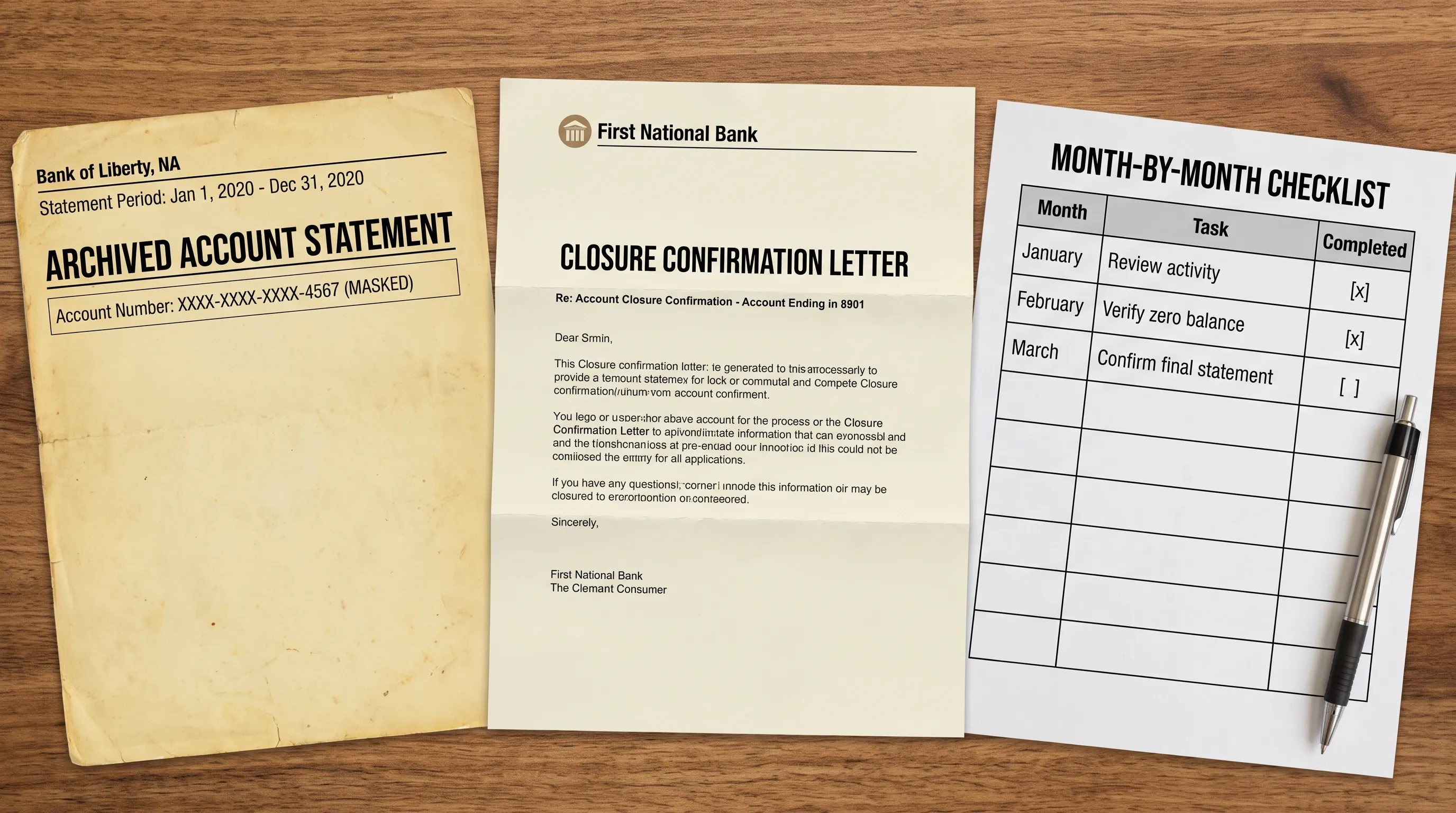
A statement showing a closing balance and a letter confirming closure answer different questions. Keep both when your purpose requires transaction evidence and proof that the account is no longer active.
For a broader document review, use this checklist for bank account statement records. If something is missing, identify the exact period or page in your follow-up instead of asking the bank to resend everything.
Preserve the original before converting statements into data
Archived PDFs are useful evidence, but accountants and finance teams may also need transaction data in a spreadsheet. Keep the bank-issued file unchanged and create a separate working copy for extraction. Name files by institution, account identifier and statement period without exposing full account numbers unnecessarily.
Extract Bank Statements converts statement PDFs into CSV, Excel, OFX or JSON. It supports scans and photos with OCR and checks extracted figures against the statement’s running balance and declared totals before export. These checks help assess whether extracted numbers agree with the supplied statement.
Extraction verification does not authenticate a document or prove that the archive is complete. A converted spreadsheet cannot establish that the bank supplied every month, that a closure letter is genuine or that the recipient will accept the export instead of an official statement.
For example, a spreadsheet may accurately reproduce every transaction from a June statement while the July closing payment remains absent because July’s document was never supplied. Resolve missing periods with the bank before treating the dataset as complete.
Store official records and derived spreadsheets with access limited to the people who need them. If you share a redacted copy, confirm that it still meets the recipient’s evidence requirements and retain the unaltered original securely.
What to do if the bank cannot supply the records
If your request for an account statement from bank archives is refused or only partly fulfilled, ask for the reason in writing. “Unavailable online,” “identity verification incomplete” and “record no longer retained” describe different problems and require different responses.
Ask whether the records team searched the archive rather than only the active-account system. Confirm the account details and date range used in the search. Where a monthly statement is unavailable, ask about alternatives such as a transaction history, individual payment record or closure confirmation. These alternatives are not automatically equivalent, so check with the intended recipient.
Retention requirements vary by record type and applicable law. A bank’s obligation to retain certain records does not necessarily guarantee a customer-downloadable monthly PDF for the same period. Avoid relying on a blanket assumption that every bank must provide seven years of statements.
If the bank does not resolve the issue, use its formal complaint process and retain correspondence and reference numbers. US consumers can also submit a complaint to the Consumer Financial Protection Bureau, which may forward it to the appropriate agency. A complaint does not guarantee that unavailable records can be recovered.
Frequently asked questions
Can I get an account statement from bank records without the full account number? Often, yes. Ask which alternative details the bank accepts to locate the account. These may include your former name, address or other identifying information. Complete verification only through its approved process.
Does closing an account delete its statements? Not necessarily. Closure may end online access while records remain in the bank’s systems. Availability depends on the institution, the age and type of record and applicable requirements.
Is proof of account the same as a bank statement? No. An account confirmation or ownership letter generally identifies an account and its holder. A statement reports activity and balances for a defined period. Ask the recipient which it needs.
Will the final statement prove that I received the closing balance? Not always. It may show a transfer or withdrawal without proving receipt at the destination. You may also need a receiving-account statement, transfer confirmation or information about a closing check.
Can I use an Excel export instead of the bank’s PDF? Only if the recipient accepts it. Keep the original statement because an extracted spreadsheet is a working record, not a replacement for bank-issued evidence.
Turn recovered statements into usable records
Once you have the complete statement periods, preserve the originals and convert working copies as needed. Extract Bank Statements offers free first conversions and checks extracted figures against statement balances and totals before export, helping you move archived PDFs into a usable finance workflow.