
What Does a Bank Statement Reference Number Identify?
Thomas Gak-Deluen8 min read

A bank statement reference number usually identifies a particular transaction or payment record, not your bank account. Depending on its label and position, however, it may identify the statement document itself or display a payer-supplied reference, such as an invoice number. Banks do not all use the same labels or formats.
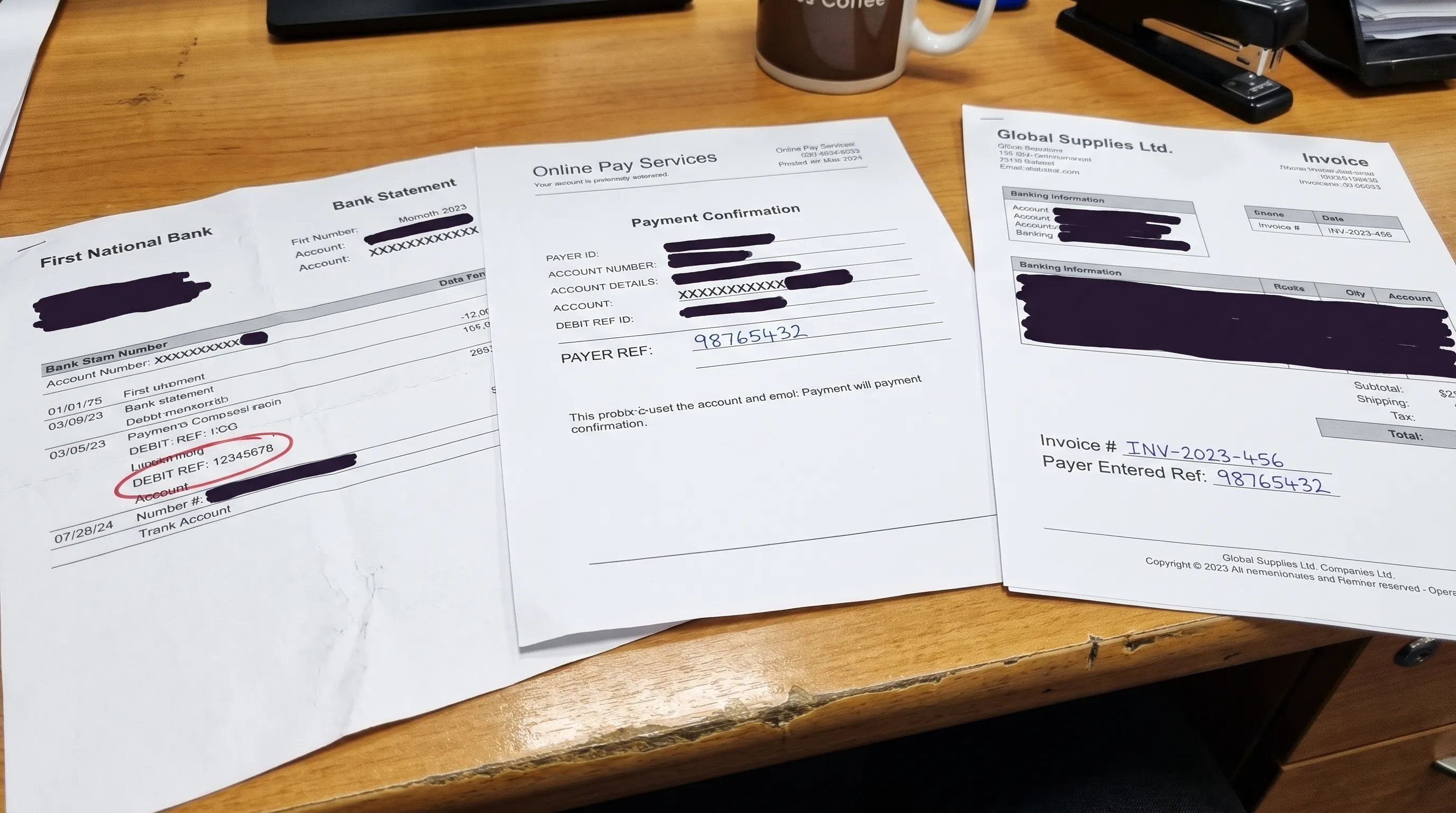
The quickest way to understand the number is to check what it sits beside. A reference beside an individual debit or credit usually relates to that entry. A reference near the statement date or page header may relate to the document instead.
If someone asks you to provide a reference, first establish whether they need an identifier to trace the payment, a message to match it to an invoice or a separate bank reference letter.
What a bank statement reference number can identify
The word “reference” describes several different fields. Their purpose matters more than their length or whether they contain letters.
| Reference type | What it identifies or communicates | Typical context |
|---|---|---|
| Bank-generated transaction reference | A transaction record within a bank or payment system | Beside a payment or inside transaction details |
| Payer-entered payment reference | A message intended to help identify a payment’s purpose | An invoice number, customer ID or rent reference |
| Statement document reference | A particular statement or document | Near the header, statement period or download details |
| Bank reference letter | Information supplied by a bank for a third party’s assessment | A separate application or due-diligence process |
A transaction reference is not your account number. Your account number identifies an account, while a routing number identifies a financial institution for the relevant payment purpose. Neither identifies a single purchase or transfer.
A check number is different again: it identifies a particular check within an account’s check sequence. If that is the field you need, see where to find your bank check number.
Where to find the right reference
To find a bank statement reference number, start with the relevant transaction rather than searching for a number of a particular length. Match the amount, currency, approximate date and payer or recipient name first.
On a PDF statement, look beside or immediately below the transaction description. Some banks wrap descriptions across several lines, so a reference may appear beneath the merchant name rather than in its own column. Searchable PDFs can be searched for labels such as “reference,” “transaction ID,” “payment details” or “confirmation.”
In online banking or the mobile app, open the transaction’s expanded details. A monthly statement may show an abbreviated description while the transaction screen or downloadable payment confirmation provides additional identifiers.
If nothing suitable appears, ask the bank which reference is available for that payment type. You generally retrieve a bank-generated reference from an existing payment record; you do not create one yourself. A payer-entered reference, by contrast, is normally supplied when arranging the payment.
Do not decide that a nine- or ten-digit number must be the reference. Account numbers and transaction identifiers vary in length, and unrelated fields can have the same number of digits.
Why the payment confirmation and statement may disagree
A payment can have more than one identifier because the sending bank, payment network and receiving institution may maintain separate records. A confirmation code and a statement reference can therefore differ without either being incorrect.
The bank statement reference number visible to you may be useful to your bank but unfamiliar to the recipient. Likewise, a recipient may want your customer reference rather than a bank-generated transaction ID.
Consider this fictional example: you enter INV-482 when paying a supplier, receive confirmation PAY-739251 and later see another reference beside the statement debit. These fields serve different purposes. The invoice reference helps allocate the money, while the bank-generated identifiers may help locate payment records.
If a recipient says they cannot find your payment, ask exactly which identifier they need and where they expect it to appear. Then provide the relevant reference alongside the amount, currency, payment date and payer name through a secure channel.
Also compare transaction status. A scheduled instruction, pending payment and posted debit are not interchangeable. The statement date may be the posting date rather than the date you initiated the transfer. Ask your bank to explain any remaining mismatch instead of assuming that two different IDs mean the payment failed.
What to give your bank when requesting a payment trace
Contact your bank through its official app, verified website or a trusted phone number. Explain whether the problem is a missing payment, an unrecognized debit, a duplicate charge or a reference the recipient cannot match. These may require different investigation processes.
When requesting a trace, supply the bank statement reference number exactly as displayed, together with enough context to identify the payment:
- The payment amount and currency.
- The date you initiated it and the posting date, if different.
- The payer and recipient names, plus relevant account details through the bank’s secure channel.
- Any confirmation code, payment message or recipient invoice reference.
- The current status and any information the recipient has supplied about the missing payment.
For a US ACH payment, ask whether an ACH trace number is available. For a wire transfer, ask which wire tracking reference the bank can provide. An app’s confirmation code is not necessarily the identifier used by the payment network.
Keep a record of the bank’s investigation or case number separately from the original payment reference. The case number identifies your inquiry, not the transfer itself.
Do not post an unredacted statement publicly to ask someone to decode a reference. Give full account details only when needed through a trusted, secure channel. Never disclose an online banking password, PIN or one-time security code. A trace request also does not guarantee that a completed payment can be reversed.
Does a reference number prove that a payment arrived?
Not by itself. A reference is an identifier, not independent proof of settlement, recipient credit or document authenticity. Someone can copy a genuine-looking reference into an altered document, and an initiation confirmation may describe an instruction that has not completed.
A bank statement reference number becomes more useful when it agrees with other evidence: the amount, currency, parties, transaction status and the bank’s own records. A posted debit shows that the bank recorded an outgoing transaction, but a recipient disputing receipt may still need its bank to investigate the incoming side.
For larger or disputed payments, distinguish between a screenshot, a downloadable confirmation and a statement entry. Each records a different part of the process. Our guide to what a bank receipt records and what it can prove explains why supporting documents should be assessed together.
If you do not recognize a transaction, contact your bank promptly rather than waiting until you can interpret every abbreviation. Ask about the appropriate dispute process and any applicable reporting deadlines. Do not send another payment simply because an unfamiliar caller claims the original reference is invalid.
Keep references usable for bookkeeping and reconciliation
For accounting work, the goal is to connect a bank entry with the right invoice, receipt or customer account. A reference helps make that connection, but it should not replace checks on the amount, date and counterparty.
Store the bank statement reference number as text when transferring it into a spreadsheet. That helps preserve leading zeros and prevents long numeric strings from being rounded or displayed in scientific notation. Keep payer-entered references in a separate field when possible, rather than combining every identifier into one column.
Preserve the original statement and enough context to return to the source entry, such as the statement period and transaction description. Do not treat a reference as a globally unique key: its uniqueness may be limited to a particular bank or system, while customer-entered messages can repeat.
Georgia businesses seeking ongoing help in English or Spanish can explore Archie Contable’s bookkeeping services. Whichever provider handles your records, retaining both the bank-generated identifier and the invoice reference makes payment-matching questions easier to resolve.
Finally, keep arithmetic verification separate from reference matching. Correct opening and closing balances can help validate extracted figures, but they do not establish that a payment was authorized or matched to the correct invoice.
Frequently asked questions
Is a bank statement reference number the same as a transaction ID? Sometimes. Banks may use those labels for the same field, but a statement can also contain a document reference or payer-entered message. Check the label, location and transaction details before treating the terms as equivalent.
How do I get a reference number for a bank transfer? Open the completed transfer in your bank’s app or online banking service and check its details or payment confirmation. If the needed identifier is not shown, ask the bank which reference it can provide for tracing that payment.
Can the recipient see the same reference I see? Not always. The recipient may see the payer’s message or a receiving-bank reference rather than your bank’s internal ID. Ask what information the recipient needs before sending a screenshot or statement.
Does every transaction have a reference printed on the statement? No. Statements vary in how much detail they display. An identifier may be available only in expanded transaction details, on a separate confirmation or from the bank.
Is a bank reference for an application the same thing? No. That usually means a bank reference letter or other information supplied for an assessment. Ask the requesting organization what document it requires rather than submitting a transaction identifier.
Convert statement data without losing the source context
Once you know what each bank statement reference number represents, keep it attached to the relevant transaction when preparing records for accounting or review.
Extract Bank Statements converts bank statement PDFs into CSV, Excel, OFX or JSON and supports scans and photos with OCR. It checks extracted figures against the statement’s running balance and declared totals before export.
Those checks help establish numerical consistency. They do not verify payment ownership, authorization or receipt by the intended beneficiary. Review important reference fields against the original document and use your bank’s investigation process when a payment needs tracing.