How to Audit a Credit Card Monthly Statement Before Payment
Thomas Gak-Deluen9 min read

Before you pay a credit card monthly statement, check three things: the balance adds up, the posted transactions belong to you and the payment instructions reflect what you actually owe. A statement can be mathematically correct and still contain an unauthorized purchase, duplicate charge or missing refund.
This review is different from reconciling a checking account. Credit card purchases generally increase what you owe, payments reduce it and interest can depend on several balances with different rates. The amount shown in your app today may also differ from the bill issued at the end of the billing cycle.
Use the checks below before approving payment. Keep the original statement and supporting records together so any exception has a clear trail from the charge to its resolution.
1. Identify the credit card monthly statement and payment deadline
Download the completed statement PDF from the issuer’s official app or website. Confirm the account holder, last four card digits, billing period and page count. An activity screen is useful for recent transactions, but it does not replace the closed statement.
Record the payment due date before starting the audit. If the deadline is close, investigate discrepancies promptly rather than allowing the review itself to cause a late payment.
Distinguish the main figures:
| Figure | What it means | How to use it |
|---|---|---|
| Statement balance or new balance | Amount owed when the billing cycle closed | Starting point for checking the monthly bill |
| Current balance | Updated balance reflecting subsequent account activity | Check purchases, payments and credits after closing |
| Minimum payment due | Minimum required payment for that bill | Avoid assuming it will prevent interest |
| Available credit | Remaining borrowing capacity, potentially affected by pending activity | Do not treat it as the amount due |
For eligible purchases, paying the full statement balance by the due date generally preserves the grace period if your account meets the issuer’s terms. If you have been carrying a balance, check those terms rather than assuming one full payment immediately eliminates all interest.
2. Reconcile the opening balance to the closing balance
Your credit card monthly statement should explain how the previous balance became the new balance. Recalculate that movement before examining individual purchases.
For a typical statement:
Previous balance + purchases + cash advances + balance transfers + fees + interest - payments - credits = new balance.
Include other adjustments, such as returned payments, where the statement shows them. Follow the issuer’s categories so you do not count a fee or adjustment twice.
Here is an illustrative reconciliation:
| Component | Effect on amount owed |
|---|---|
| Previous balance | $1,240.00 |
| Purchases | +$1,685.00 |
| Cash advances | +$150.00 |
| Fees | +$12.00 |
| Interest | +$23.00 |
| Payments | -$1,000.00 |
| Credits | -$85.00 |
| Calculated new balance | $2,025.00 |
Next, compare the transaction-detail totals with the summary categories. A summary that adds up does not prove every transaction was captured correctly in a spreadsheet.
If you extract the PDF, check signs carefully. Some issuers display payments as negative amounts; others place positive amounts in a separate credit column. Apply one consistent convention without changing the original evidence. Also inspect multiline descriptions, page breaks and transactions carried over onto the next page.
3. Match posted charges to receipts and approvals
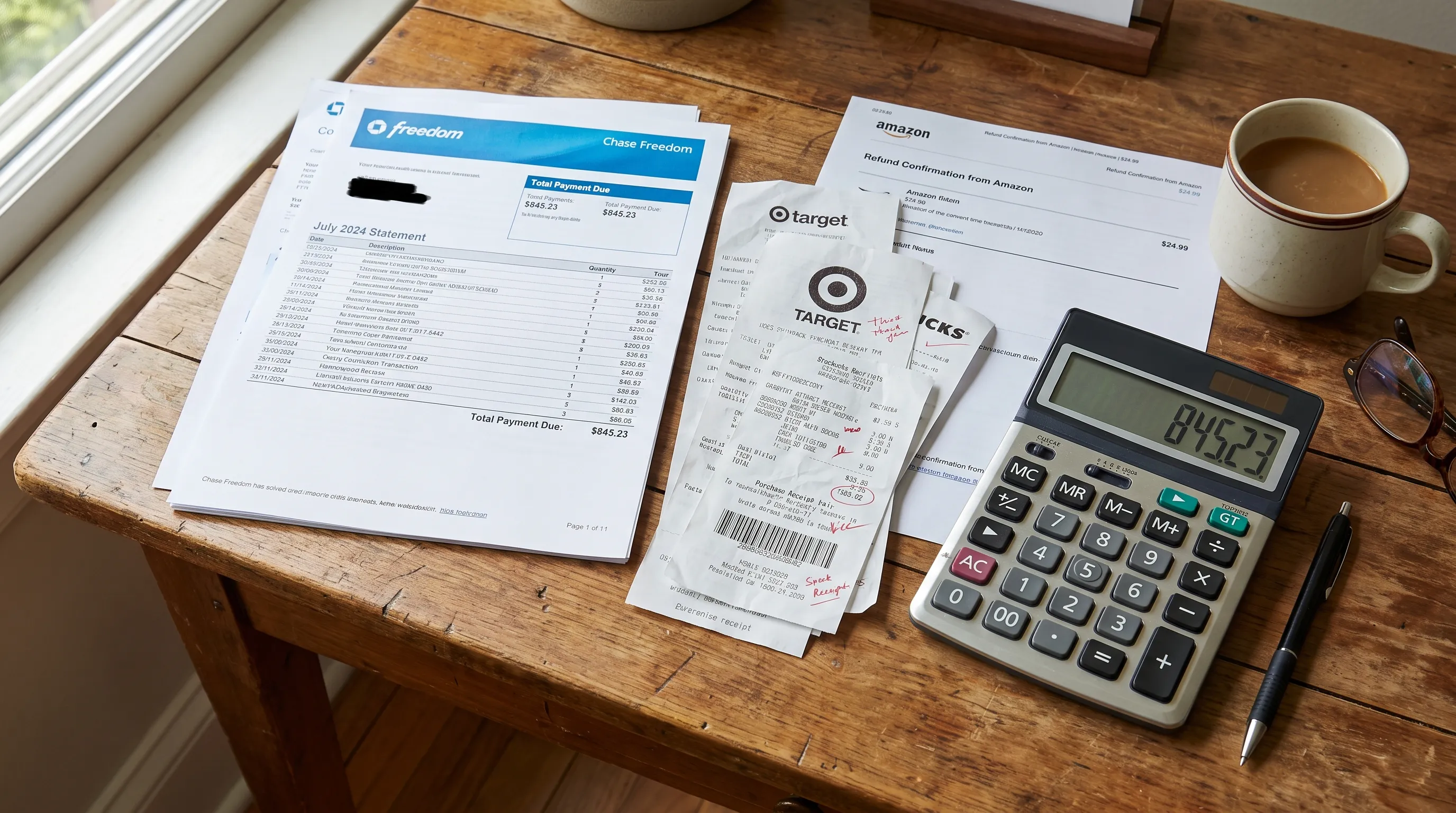
Review each posted purchase on the credit card monthly statement against a receipt, order confirmation, subscription record or other supporting evidence. Compare the merchant, amount, currency and transaction date, allowing for a different posting date.
An unfamiliar merchant descriptor is not automatically fraud. It may identify a parent company, payment processor or marketplace seller. Check your purchase history and authorized users, but contact the issuer immediately if the card appears compromised.
Pay particular attention to identical amounts, renewed subscriptions and final restaurant or hotel charges. A pending authorization and a posted purchase are not necessarily two completed charges. For genuinely repeated posted entries, the same evidence-based approach used to investigate duplicate transactions helps distinguish an error from two legitimate purchases.
For a business card, confirm authorization and business purpose as well as the amount. For example, when reviewing a booking for executive or event transportation, match the charge to the supplier invoice, service date and approved trip. Check any additional charges against the agreed booking terms rather than approving them solely because the supplier is familiar.
For foreign-currency purchases, compare the original-currency receipt with the statement’s converted amount and any separately disclosed foreign transaction fee. The receipt total alone will not establish the final billed amount in your card’s currency.
4. Check interest, fees and promotional terms
The interest and fee sections of a credit card monthly statement deserve their own review, especially when purchases, cash advances and promotional transfers carry different annual percentage rates (APRs).
Compare each rate with your account terms and any notices of changes. Look at the balance subject to interest, not just the closing balance. Depending on the account agreement, interest may use daily balances, transaction timing and separate rate categories. Multiplying the closing balance by one-twelfth of the APR may not reproduce the issuer’s calculation.
Check annual fees, late fees, cash advance fees and balance transfer fees against the applicable terms. If a late fee appears despite an on-time payment, collect the payment confirmation and credited date before contacting the issuer.
Promotional balances need a separate deadline check. A true 0% introductory APR is different from deferred interest. With a deferred-interest offer, interest may become payable if the promotional balance is not paid in full by the specified deadline.
Cash advances commonly begin accruing interest without a purchase-style grace period. If you previously carried an interest-bearing balance, ask about residual interest that may accrue between the statement closing date and receipt of your payment. The latest statement balance may not be a complete payoff figure.
5. Trace payments, refunds and other credits
A missing credit can make a credit card monthly statement look wrong even when the explanation is timing. Establish whether the payment or refund should have posted before the statement closed.
Match payments to both sides of the transfer: the debit from your bank account and the credit on the card account. A scheduled payment is not the same as a completed payment. A bank debit also needs investigation if the card account does not show the corresponding credit.
For refunds, retain the merchant’s confirmation, amount and expected processing timeframe. A promise to issue a refund is not a posted credit. If it arrived after closing, it may appear in current activity rather than on the completed statement.
Do not assume a refund satisfies the minimum payment or automatically changes an upcoming autopay withdrawal. Confirm the remaining payment requirement and scheduled debit with the issuer. Likewise, check for a returned payment that reversed an earlier credit.
When tracing the bank side, a separate checking account statement review can help establish whether money actually left the funding account.
6. Document and dispute unresolved errors promptly
Create an exception record for each unresolved item. Capture the statement date, transaction date, merchant, amount, reason for concern and supporting evidence. Keep case numbers and copies of correspondence as the investigation progresses.
An unexplained charge on a credit card monthly statement should not disappear from your working records simply because you expect a refund. Keep it visible until the issuer or merchant resolves it, then verify the actual adjustment.
For US consumer credit cards, the Consumer Financial Protection Bureau’s billing-error guidance explains the written dispute process. To preserve federal billing-error protections, send written notice to the designated billing-inquiries address within 60 calendar days after the issuer sent the first statement containing the error. That address may differ from the payment address.
Calling or using an app can help initiate an investigation quickly, but do not assume it replaces the written notice required to preserve those protections. Report suspected unauthorized use immediately rather than waiting for the deadline.
During a qualifying billing-error investigation, you generally do not have to pay the disputed amount or related charges, but you still need to pay undisputed amounts on time. Confirm the required payment and autopay handling with the issuer instead of canceling all payments. Federal consumer billing-error protections generally do not apply to business-purpose cards in the same way, so business users should check their agreement and dispute procedures.
7. Approve the payment separately from the bookkeeping
Once exceptions are identified, decide what must be paid by the due date. Then reconcile that decision with payments and credits posted since closing. Avoid sending a second payment merely because the original PDF still shows the full balance.
Your credit card monthly statement review should end with a recorded payment decision, not just a marked-up transaction list. Note the amount, payment date, funding account and treatment of any disputed items.
Before approval, confirm:
- The amount: Check the remaining statement obligation and any arrangement confirmed with the issuer.
- The method: Verify whether manual payment or autopay will handle it and whether both are scheduled.
- The funding: Confirm the selected bank account has sufficient available funds.
- The evidence: Save the statement, reconciliation, exception records and payment confirmation together.
For bookkeeping, avoid recording the card payment as a second expense when purchases have already been recorded. The payment normally settles the card liability. Follow up after processing to confirm the payment posted successfully and no unexpected balance remains.
Frequently asked questions
What is the statement amount on a credit card? It usually means the statement balance, also called the new balance: the amount owed when the billing cycle closed. It differs from the minimum payment and may differ from today’s current balance.
How can I see my credit card monthly statement? Sign in through the issuer’s official website or app and look for statements or documents. Download the PDF for the relevant billing cycle. If it is unavailable or incomplete, request a copy from the issuer.
Does a reconciled statement prove every charge is valid? No. Reconciliation proves that the figures agree mathematically. You still need to check whether purchases were authorized, fees follow the agreement and expected refunds were received.
Should I pay only the minimum while checking the bill? Paying the minimum does not generally prevent interest. Separate legitimate amounts from disputed items, follow the applicable dispute procedure and confirm the required payment with the issuer before the due date.
Make the numerical checks easier
For longer statements, Extract Bank Statements can convert credit card PDFs, scans and photos into Excel or CSV for review. It checks extracted figures against the statement’s available running balances and declared totals before export.
That verification supports the arithmetic part of the audit; it does not establish whether a purchase was authorized or a fee was contractually correct. Try your first conversions free, retain the original PDF and use the extracted data alongside your receipts and exception records before approving payment.