
How AWS OCR Fits Into a Bank Statement Extraction Pipeline
Thomas Gak-Deluen13 min read
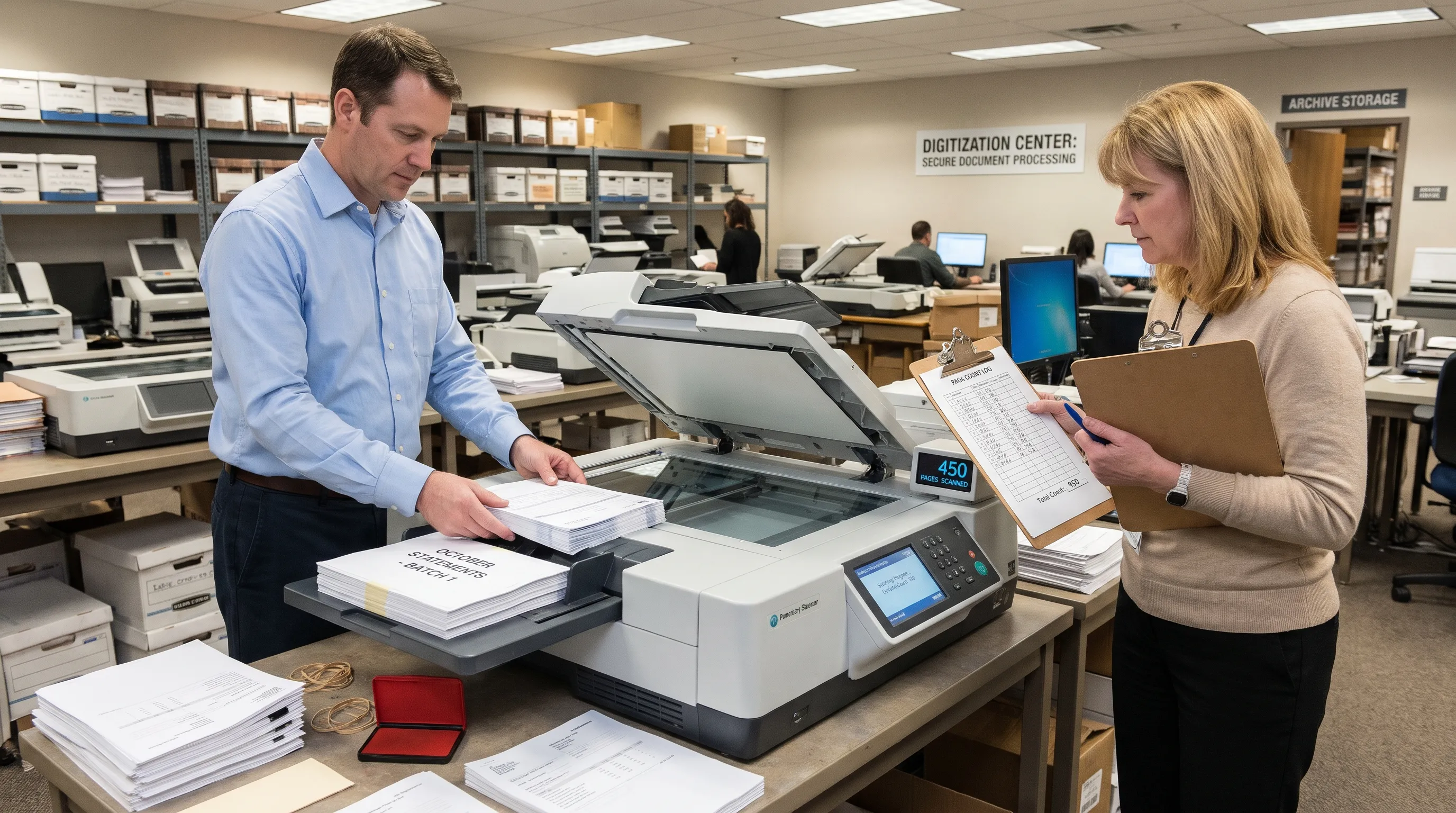
If you’re researching “ocr aws” for bank statements, Amazon Textract is the AWS service most directly relevant to extracting document text and tables. But reading a statement is only one stage of producing trustworthy financial data. A successful API response does not establish that every transaction was captured, debit and credit signs are correct or the closing balance reconciles.
A production pipeline must connect document intake, extraction, transaction reconstruction, financial validation and controlled export. This guide explains where Textract belongs, what you need around it and how to evaluate the complete workflow before relying on its output.
What Amazon Textract extracts, and what it does not
Amazon Textract provides OCR and document analysis through APIs. Text-detection operations return recognized text with location information. Document-analysis operations can also identify structures such as tables, form fields and query answers, depending on the requested features.
For bank statements, tables are often the useful starting point. Textract returns blocks and relationships describing words, cells and table structures. Your application must interpret those relationships rather than treating the response as an already normalized transaction ledger.
AWS OCR does not inherently determine whether a statement reconciles. It also does not supply a universal bank-statement schema with correctly classified opening balances, transaction signs and statement totals.
A number recognized accurately can still be assigned to the wrong row. A perfectly extracted closing balance can coexist with a missing transaction page. These are interpretation and completeness problems, not simply character-recognition errors.
AnalyzeExpense is designed for invoices and receipts. Its existence should not be taken as evidence of a dedicated, financially verified bank-statement parser.
Where “ocr aws” fits in the architecture
Keep extraction and verification as separate stages with explicit outputs. This makes failures diagnosable and lets you replace recognition components without rewriting accounting rules.
| Stage | Typical implementation | Required output |
|---|---|---|
| Intake | Amazon S3 and application checks | Identified source file and processing record |
| Recognition | Amazon Textract | Text, geometry, tables and confidence values |
| Interpretation and verification | Application workers and financial rules | Normalized transactions with validation results |
| Delivery | Export service or downstream API | Approved records with source references |
Amazon SQS can buffer work, while AWS Step Functions can coordinate stages and exception paths. Neither service supplies the financial interpretation itself.
Before invoking AWS OCR, inspect the PDF. A digitally generated statement may contain usable embedded text, allowing a separate text-extraction path. Check its reading order and completeness against the rendered pages before trusting it.
Scans and photos require image recognition. Check page count, orientation, cropping and readability at intake. Preserve the original file even if you create deskewed or enhanced derivatives. Reject unsupported or inaccessible files explicitly instead of exporting an empty result that looks successful.
Choose synchronous or asynchronous processing
Use synchronous processing when the document fits the operation’s supported limits and your application needs an immediate response. DetectDocumentText handles text recognition; AnalyzeDocument adds requested structural features.
For multipage bank-statement PDFs, asynchronous processing is generally the more appropriate design. Start a job with StartDocumentAnalysis, retain its identifier and retrieve results through GetDocumentAnalysis after completion. The corresponding text-only operations are StartDocumentTextDetection and GetDocumentTextDetection.
AWS documents the synchronous workflow and asynchronous workflow, including supported inputs and restrictions. Check current file-size, page-count and regional limits before implementation.
PDFs can be submitted directly when supported; converting every page to JPEG is not a prerequisite.
Choose the AWS OCR execution mode for document requirements and workflow reliability, not because asynchronous processing supposedly guarantees better recognition or lower per-page pricing. Avoid keeping a web request open while a long-running statement job finishes.
A minimal Python integration
This example starts table analysis and collects results after a separate completion notification or scheduled status check. It deliberately stops before transaction interpretation.
import boto3

textract = boto3.client("textract")


def start_statement(bucket, key, processing_id):
    response = textract.start_document_analysis(
        DocumentLocation={
            "S3Object": {"Bucket": bucket, "Name": key}
        },
        FeatureTypes=["TABLES"],
        ClientRequestToken=processing_id,
    )
    return response["JobId"]


def collect_completed_job(job_id):
    blocks = []
    request = {"JobId": job_id}

    while True:
        response = textract.get_document_analysis(**request)
        if response["JobStatus"] != "SUCCEEDED":
            raise RuntimeError(response["JobStatus"])

        blocks.extend(response.get("Blocks", []))
        token = response.get("NextToken")
        if not token:
            return blocks
        request["NextToken"] = token
Generate a valid, stable processing_id for the specific source version and processing configuration. Persist the job identifier before acknowledging the task. Never reuse the same idempotency token for changed parameters.
The GetDocumentAnalysis documentation describes pagination, statuses and warnings. NextToken paginates API results, not necessarily individual document pages.
Production code must also preserve metadata, inspect warnings and distinguish failure from partial success. Do not call this collector repeatedly in a tight loop while a job is running. Use notification-driven processing or bounded polling with backoff, and treat incomplete results as exceptions requiring an explicit decision.
Reconstruct transactions before applying accounting rules
The next task is turning document structure into financial records. Define a canonical schema containing posting date, description, debit, credit, running balance, currency and source reference. Keep value dates separate when present.
AWS OCR output needs interpretation around wrapped descriptions, repeated headers and transactions that cross page boundaries. A table cell is not necessarily a complete transaction, and a printed line is not necessarily a new row.
Retain page numbers and bounding boxes for important fields. Store raw recognized text alongside normalized values so a reviewer can compare the interpretation with the source.
Handle dates and amounts explicitly. Establish whether 03/04 means March 4 or April 3 from reliable document context. Distinguish thousands separators from decimal separators, and use decimal arithmetic rather than binary floating-point numbers for monetary checks.
Do not silently infer an unreadable amount because one value would make the balance equation work. Record it as unresolved and present the candidate interpretation for review.
For layout-specific failure patterns, our guide to preserving transaction rows during scanning and OCR explains why page quality and row reconstruction need separate checks. The AWS implementation should preserve enough evidence to diagnose both.
Validate balances independently of recognition confidence
Financial validation asks whether the interpreted records agree with the statement. It should use source-declared balances and totals, not totals calculated solely from the extracted transaction list.
For a conventional deposit account, a basic check is:
opening balance + credits - debits = closing balance
Apply running-balance checks between transactions wherever the statement supplies them. Consider this illustrative USD statement:
| Entry | Credit | Debit | Printed balance |
|---|---|---|---|
| Opening balance | $2,500.00 | ||
| Payroll | $1,200.00 | $3,700.00 | |
| Rent | $950.00 | $2,750.00 | |
| Fee | $15.00 | $2,735.00 |
If rent becomes $95.00, the balance after that transaction is wrong by $855.00. The discrepancy gives the reviewer a specific location to inspect, even if recognition confidence was high.
AWS OCR should feed these checks, not substitute for them. Also compare declared debit and credit totals, page continuity, statement dates and currency consistency where the source provides sufficient evidence.
Adapt the equations for credit cards and other account conventions. Purchases and payments do not necessarily follow deposit-account sign logic.
A reconciled statement is internally consistent, not proven authentic. Offsetting errors can preserve a closing balance, and aggregate checks are weaker when transaction-level balances are absent. Record which checks were possible, which passed and which remain unresolved.
Use confidence to route work, not certify correctness
Textract confidence values help identify uncertain recognition. They are not calibrated guarantees that a complete transaction record is financially correct. A highly confident amount can still belong to another column.
Set review policies using measured outcomes from your documents. A single universal confidence cutoff ignores the difference between a merchant-description typo and a wrong amount.
An AWS OCR workflow should combine recognition signals with financial checks and extraction completeness. Route missing pages, ambiguous signs, balance discrepancies and unresolved currencies to review even when individual words look reliable.
The review interface should show the relevant source crop, surrounding transactions, interpreted fields and failed checks. Let reviewers correct values without overwriting the original evidence. Record who changed what and which validations passed afterward.
Separate technical retries from financial review. A throttled API call may succeed later; a cropped balance column usually needs a replacement file or human decision. Repeatedly processing the same damaged image is not a resolution strategy. Handwritten annotations also need explicit interpretation rather than automatic inclusion in the transaction ledger.
Evaluate the complete pipeline on representative statements
Build a benchmark before optimizing prompts, features or thresholds. Include representative banks, layouts, currencies, statement lengths and document sources, with deliberately difficult examples rather than only clean PDFs.
Include low-resolution scans, rotated pages, faint printing, phone photos, multipage tables and handwritten annotations. Label handwriting separately so its performance does not disappear inside an overall average.
Measure AWS OCR performance at several levels: character recognition, exact amount accuracy, correct field assignment, complete transaction capture and final statement reconciliation. A high text-recognition score can conceal missing rows.
Create independently checked reference records. For each test document, compare transaction count, dates, debit and credit amounts, balances and totals. Track the percentage of statements exported without correction, plus the percentage incorrectly approved.
Split development and final evaluation sets by layout or bank family where practical. Otherwise, repeated templates can make generalization appear stronger than it is.
Choose acceptance criteria from the consequences of failure. Report results separately for clean digital statements and difficult scans, and retain a regression set for every parser change. Our guide to choosing OCR for verified financial data covers the broader procurement questions that complement this AWS-specific benchmark.

Make processing recoverable and traceable
Queue-backed pipelines must tolerate duplicate delivery. Use a processing record that distinguishes source identity, extraction version and export status. A retried completion message must not insert the same transactions twice.
A content hash helps detect identical uploads, but it will not identify every duplicate statement. Two scans of the same pages can have different hashes. Separately flag overlapping account periods and matching transaction sequences for investigation.
For AWS OCR operations, apply bounded retries with exponential backoff and jitter to retryable failures. Send exhausted jobs to a dead-letter queue with enough context to investigate safely.
Treat PARTIAL_SUCCESS as a distinct outcome. Compare expected and processed pages, inspect warnings and prevent incomplete documents from passing through ordinary export approval.
Store the source reference, job identifier, parser version, configuration and validation report together. Persist results within the service’s documented availability period rather than assuming they remain retrievable indefinitely.
Make export idempotent too. Maintain stable transaction identifiers and a delivery record so a downstream timeout does not cause duplicate imports. Monitor queue age, failed jobs, review backlog and incorrect approvals separately; one average processing-time metric will not reveal these different operational risks.
Estimate cost from billable work and exception handling
Use the current Amazon Textract pricing for your region, requested features and volume tier. Avoid quoting one universal OCR price: text detection and structural analysis are different workloads.
A practical estimate is:
Textract charges + storage + orchestration + compute + transfer + human review
Calculate Textract charges from billable pages for each applicable API or feature combination, using the relevant pricing tiers. Do not assume enabling extra features is free.
For example, 20,000 statements averaging six pages produce 120,000 input pages. If 20% of those pages receive one additional chargeable processing pass, plan for 144,000 page-processing instances. This is an illustrative workload calculation, not a service-price quote.
Measure retries and reprocessing separately. Retrying a result-retrieval request is not equivalent to starting another analysis job.
AWS OCR costs also depend on routing. Reliable embedded-text extraction may avoid some recognition calls, while optional form or query analysis should justify its additional expense through measured accuracy or reduced review.
Finally, estimate review minutes per exception and the exception rate from your benchmark. Include engineering maintenance and downstream correction work. The useful comparison is cost per correctly delivered statement, not merely cost per recognized page. Track this measure by document category so difficult scans do not hide behind cheaper digital inputs.
Secure both the files and the processing path
Bank statements contain sensitive personal and financial information. Design access controls around the complete lifecycle, including uploads, temporary images, extracted JSON, review screens and exports.
Use narrowly scoped IAM permissions, private storage and encryption in transit and at rest. Where appropriate, manage encryption keys through AWS KMS. Limit workers to the buckets, prefixes and operations they actually require.
Keep account numbers, transaction descriptions and document contents out of routine application logs. Review access to debugging artifacts, not just the original S3 objects.
AWS OCR security also involves regional service availability, storage locations, retention rules and deletion behavior. Follow the Textract security documentation and your organization’s contractual and regulatory requirements. Selecting an AWS region alone does not establish compliance.
Define retention for every derivative, including source crops and failed-job payloads. Test deletion across those locations.
At export, distinguish numeric fields from untrusted descriptive text. Spreadsheet-compatible files should handle formula-like descriptions safely without changing the canonical financial record. Restrict download access and make temporary links expire. Include human-review vendors and support access in the same security assessment as the cloud infrastructure.
Decide what to build and what to buy
Textract can be sufficient when your requirement is recognized text or document structure and your team already owns normalization, verification and review tooling. It is a component rather than a turnkey statement-to-ledger system.
Build around AWS OCR when custom orchestration, existing AWS controls or specialized downstream systems justify maintaining the remaining pipeline. Budget for layout changes, evaluation datasets, exception handling and operational support.
Consider a statement-focused service when the required output is verified transaction data rather than OCR blocks. Compare alternatives on representative documents and inspect failure behavior, source traceability, export formats and security terms.
Use the same acceptance tests for both approaches. Ask whether a missing page blocks export, whether balance discrepancies remain visible and whether corrected records retain their source evidence.
The boundary is responsibility: decide which team or supplier owns each step between file upload and approved export. An extraction API does not remove that responsibility; it changes which components you maintain.
Frequently asked questions
Is AWS OCR an AI service? Amazon Textract uses machine learning to recognize text and document structures. That does not mean its output automatically satisfies accounting rules or establishes document authenticity.
Can Textract convert a bank statement directly to Excel? Its APIs return structured extraction results rather than a finished, verified workbook. Your application must reconstruct transactions, validate them and generate the spreadsheet, or use a service that handles those stages.
Should every statement use table analysis? No. Test the simplest extraction path that meets your requirements. Embedded PDF text may be sufficient for some documents, while other layouts benefit from table analysis or additional interpretation. Compare complete transaction accuracy, not just how organized the response looks.
Can a statement pass balance checks and still contain errors? Yes. Offsetting mistakes can preserve totals, and a correct amount can have the wrong description or date. Combine financial checks with completeness testing, field-level evaluation and source traceability.
Start with the output you need
If you want usable financial exports rather than an OCR integration project, Extract Bank Statements converts statement PDFs into CSV, Excel, OFX or JSON and checks figures against the statement’s running balances and declared totals. It supports scans and photos with OCR, plus REST API access for automated workflows.
Use the free first conversions to test representative statements against your acceptance criteria. Compare transaction completeness, verification results and review effort before choosing your production approach.