
Which Bank Document Do You Need for Proof of Funds?
Thomas Gak-Deluen8 min read

The right bank document for proof of funds is usually a recent bank statement or a bank-issued letter confirming your balance. The correct choice depends on who is asking and what they need to verify: ownership, available cash or the history behind a deposit. An account-ownership letter alone may not show enough, and a screenshot may not meet the recipient’s requirements.
Before requesting anything from your bank, get the recipient’s document checklist. That can save you from paying for a letter that leaves out a required detail or submitting statements that are too old.
Start with what you need to prove
“Proof of funds” generally means evidence that you hold enough acceptable money for a specific purpose. It is not automatically proof of income, proof of account ownership or proof that a payment was completed.
A recipient might need a current balance for a purchase, several months of account history for underwriting or evidence explaining where a large deposit came from. Those are different requests, even when they concern the same account.
Ask for the required document type, issue date, reporting period and delivery method. Also confirm whether the funds must be immediately accessible and whether joint, business or foreign-currency accounts are acceptable.
Which bank document fits your proof-of-funds request?
Use the following comparison to narrow your choice, then confirm acceptance with the organization reviewing it.
| Record | What it generally shows | Main limitation |
|---|---|---|
| Bank statement | Account holder, statement period, transactions and balances | The closing balance may no longer reflect available funds |
| Proof-of-funds letter or balance confirmation | A bank’s confirmation of specified balances as of a particular date | Contents vary, and the letter may not explain deposit history or restrictions |
| Account-ownership or bank-details letter | Who owns an account and identifying banking details | It may contain no balance information |
| Deposit or transfer receipt | Evidence of a particular transaction | It does not establish total funds currently available |
| Loan preapproval | A lender’s conditional assessment of borrowing eligibility | It is not evidence that you already hold cash for a down payment or purchase |
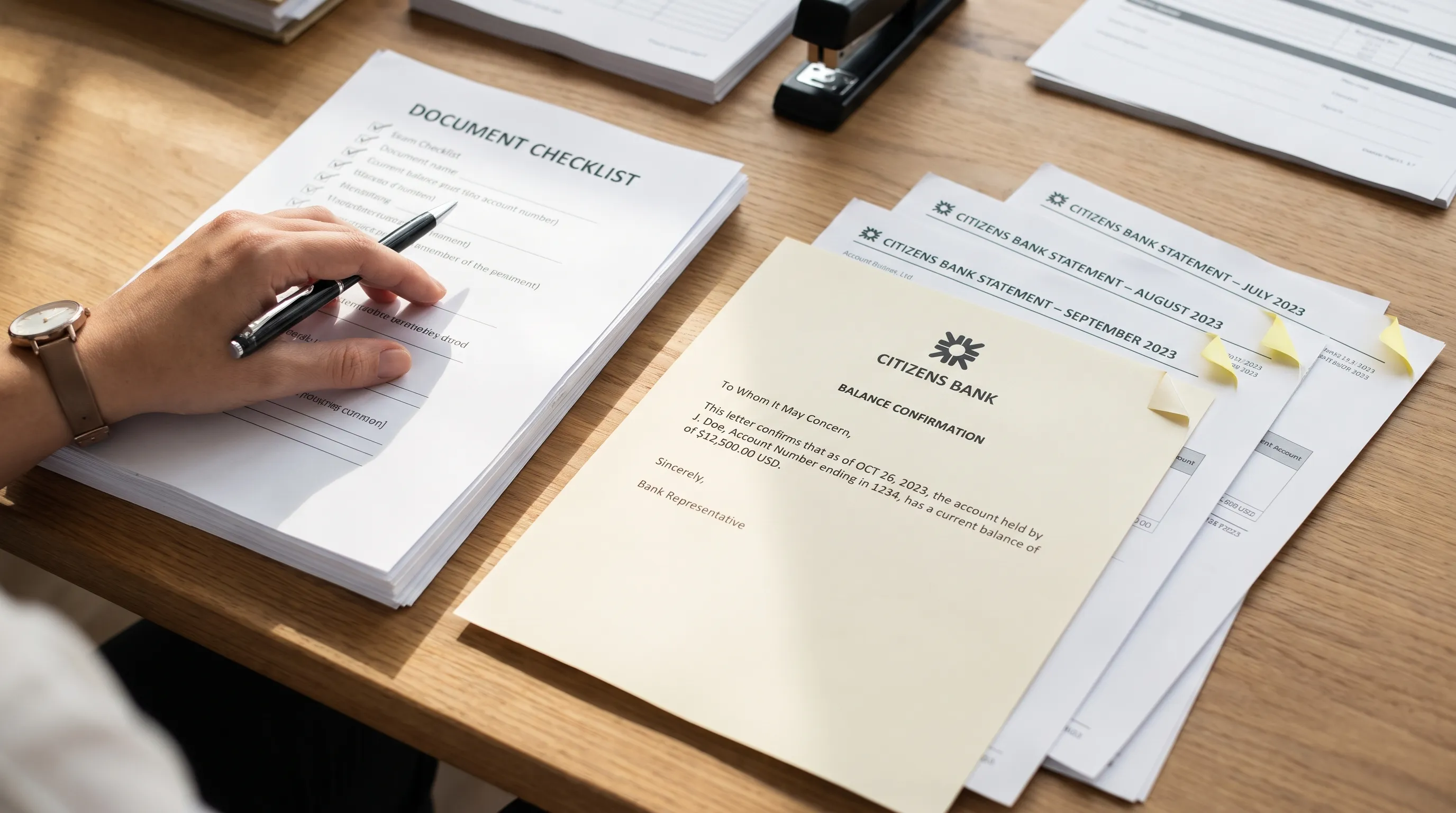
A recent statement may be sufficient when the recipient accepts it and it clearly shows the required funds. A bank-issued letter is more useful when the recipient needs a dated confirmation, specific wording or information that does not appear on a statement.
Some requests require both: a letter establishing the current position and statements explaining how the money accumulated.
What a proof-of-funds letter should include
A useful bank document connects an identifiable account holder to a specific amount, currency and date. “This customer maintains an account with us” establishes much less than “This customer held the following balance as of this date.”
Give your bank the recipient’s checklist rather than assuming its standard letter covers everything. Depending on the request, the letter may need:
- Your name or the business’s legal name, matching the application or purchase paperwork
- The bank’s name, contact details and date of issue
- Account identifiers in the format the recipient accepts
- The balance, currency and date to which the confirmation applies
- Any specifically requested information about account opening dates, average balances, debts or access restrictions
Not every request requires every item. A property seller may want a concise balance confirmation, while an immigration process may prescribe a much more detailed letter.
Ask whether a secure electronic letter is acceptable or whether the recipient requires a signature, stamp, original paper copy or direct communication from the bank. These are acceptance rules, not universal requirements.
Match the evidence to the purpose
Buying a home
For a cash offer, a seller or agent may request evidence that you can cover the purchase. For a financed purchase, the lender may need to verify your down payment, closing costs and any required reserves.
The bank document that supports an offer may not satisfy mortgage underwriting. A short balance letter can demonstrate purchasing capacity, while an underwriter may also request complete statements and explanations for recent deposits.
If the lender asks for account history, follow the requested period rather than substituting a current screenshot. This guide explains why lenders may request three months of bank statements and what they review within them.
Immigration and visa applications
Follow the instructions for the specific country, program and application stage. Requirements can extend beyond a current balance to ownership, access to funds, account history and outstanding debts.
For example, Canada’s Express Entry proof-of-funds instructions specify official financial-institution letters with details including current balances, average balances over the preceding six months and outstanding debts. The page also explains which applicants need proof and the conditions the money must meet.
That is an example of a program-specific requirement, not a template for every visa application. Check the current official instructions before asking the bank to prepare your evidence.
Business purchases and contracts
A business may need to demonstrate funds for an acquisition, equipment purchase, lease or contractual obligation. Confirm whether the recipient needs company-held cash, owner funds or evidence of committed financing.
The bank document should identify the entity that actually holds the money. A healthy sales pipeline or unpaid invoices do not establish an available bank balance.
For example, a pool service company might manage scheduling and homeowner billing in pool-service software such as SplashIQ. Those operating records help explain business activity, but they do not replace bank-issued evidence of cash. Keep forecasts, receivables and confirmed funds clearly separated in the submission.
Check that the balance represents usable money
A visible balance is not always the amount you can use for the proposed transaction. Pending withdrawals, deposit holds, pledged funds or account restrictions can affect availability. Ask the bank to clarify any difference between the statement balance and the available balance.
The recipient may also apply its own rules to investment accounts, certificates of deposit or borrowed money. An asset’s value does not necessarily establish that you can turn it into acceptable cash by the required date.
When combining accounts, identify each account separately and avoid counting the same transfer twice. Money leaving one account and entering another is a movement of existing funds, not additional money.
For foreign-currency holdings, show the original currency. If a converted total is requested, identify the conversion date and rate used, and follow the recipient’s method. An exchange-rate calculation is not a bank guarantee that the converted amount will remain unchanged.
How to request and assemble your evidence
Start with your bank’s secure online portal or official customer-service channel. Download original statement PDFs where available. If you need a letter, provide the recipient’s instructions and ask whether the bank can include the required information, how long preparation takes and whether a fee applies.
For multiple accounts, keep a simple cover summary showing the account holder, institution, currency and relevant balance date. Treat that summary as an index to the evidence, not as a replacement for it.
If funds recently moved between accounts, retain records that connect the withdrawal and deposit. A reviewer may also request supporting evidence for a gift, asset sale or other large credit. Provide what the process requires rather than assuming a transfer description establishes the source.
Before submission, compare each bank document with the checklist. Confirm the dates, name spelling, account coverage and page count. If one required item is missing, ask the bank or recipient how to resolve it instead of editing the issued record yourself.
Share enough information without oversharing
Verify the recipient and upload destination before sending financial records. For a property transaction, independently confirm any changed instructions through a trusted contact method. Do not rely solely on contact details in an unexpected email.
Ask which information may be masked. A seller might accept partial account numbers, while a lender or government process may require complete, unredacted statements. Do not hide balances, relevant transactions or identifying information that the recipient requires.
Keep an untouched original. If redaction is permitted, use a method that removes the underlying information rather than merely covering it visually. Never share your online banking password, PIN or one-time security codes as part of a proof-of-funds request.
It is also worth checking a statement’s source, completeness and consistency before sharing it. Matching totals can reveal some errors, but arithmetic alone cannot establish authenticity or ownership.
Frequently asked questions
Is a bank statement enough for proof of funds? Sometimes. A recent bank document showing your name and sufficient funds may meet the request, but some recipients require a bank-issued letter, account history or additional evidence of availability. Get confirmation before submitting.
How recent should proof of funds be? There is no single deadline that applies everywhere. Follow the recipient’s stated age limit and balance-date requirements. If your statement predates a significant withdrawal or deposit, ask whether a newer balance confirmation is needed.
Can I use a screenshot or spreadsheet instead? Only if the recipient explicitly accepts it. Screenshots may omit identifying details or dates, and a spreadsheet is not a bank-issued confirmation. Keep the original records available even when a separate summary is requested.
Does a proof-of-funds letter explain where the money came from? Not necessarily. It may confirm a balance without establishing the source of individual deposits. Source-of-funds checks can require separate evidence, such as sale documents, gift documentation or records tracing transfers between accounts.
Prepare the numbers without replacing the evidence
When you need to review transactions across several statements, Extract Bank Statements converts PDFs into CSV, Excel, OFX or JSON and checks extracted figures against the statement’s running balance and declared totals. It also supports scans and photos through OCR.
That can help you organize balances and transaction history before submission. It does not turn an export into an official bank document, prove that the source file is authentic or guarantee acceptance by a lender, seller or government agency.
Request the evidence the recipient requires, retain the bank-issued originals and use extracted data to support your review rather than replace the proof.