
What Trust Account Statements Show About Client Funds
Thomas Gak-Deluen10 min read

Trust account statements show money received, money paid out and the balance held during a reporting period. For anyone responsible for client funds, the critical question is whether those amounts can be traced to the right client and a supported purpose. A statement that adds up is useful evidence, but it does not establish that every payment was authorized or that all deposited funds are available to disburse.
First, identify which kind of statement you have
The term covers several documents with different purposes. A bank-issued trust account statement records activity in an account designated for holding entrusted funds. It generally shows the account balance, not each person’s entitlement to that balance.
A client trust ledger records receipts, payments and the amount held for a particular client or matter. In a pooled law-firm account, separate client ledgers explain how the combined bank balance is allocated.
A trustee’s accounting to beneficiaries is broader. It may report property held, income, expenses, distributions and changes in asset values. Its scope depends on the trust document and applicable law.
These documents support one another, but they are not interchangeable. A pooled account’s bank statement cannot replace individual client ledgers, and a cash statement cannot describe all the investments or property administered by a trustee.
What trust account statements should let you trace
A useful reporting package connects the opening position to the closing position and explains the transactions between them. The bank statement supplies some of that information; internal records and supporting documents supply the rest.
| Information | What it helps establish | What may require separate records |
|---|---|---|
| Account title and reporting period | Which account and dates are covered | The governing trust or client arrangement |
| Opening and closing balances | The change in bank-held funds | Each client’s share of those funds |
| Receipts and deposits | Amounts credited to the account | Source, client allocation and restrictions |
| Payments and withdrawals | Amounts debited from the account | Purpose, approval and ultimate recipient |
| Interest and charges | Bank-applied adjustments | Their correct allocation or treatment |
| Transaction references | A route to supporting evidence | Invoices, instructions and payment approvals |
For a cash account, the basic relationship is opening balance + receipts − payments = closing balance. Interest and bank charges must also be included when present.
Descriptions such as “transfer” or “check paid” are rarely enough for client-level reporting. Preserve references that connect each transaction to its ledger entry and supporting document. Also distinguish transaction dates from posting dates, especially around the reporting cutoff.
A worked example: from bank activity to client balances
The following fictional example shows how trust account statements connect to a pooled client ledger. It illustrates cash movements only, not a prescribed legal form or a beneficiary accounting.
Assume the account opens with $20,000: $12,000 belongs to Client A and $8,000 to Client B. There are no bank charges or interest during the period.
| Date | Bank activity and internal allocation | Money in | Money out | Bank balance |
|---|---|---|---|---|
| June 1 | Opening balance | $20,000 | ||
| June 4 | Deposit allocated to Client A | $5,000 | $25,000 | |
| June 9 | Authorized payment for Client B | $1,500 | $23,500 | |
| June 18 | Authorized vendor payment for Client A | $3,000 | $20,500 | |
| June 25 | Funds returned to Client A | $2,000 | $18,500 |
The corresponding client records should explain the closing balance:
| Client | Opening funds | Receipts | Payments | Closing funds |
|---|---|---|---|---|
| Client A | $12,000 | $5,000 | $5,000 | $12,000 |
| Client B | $8,000 | $0 | $1,500 | $6,500 |
| Total | $20,000 | $5,000 | $6,500 | $18,500 |
The totals agree, but authorization still needs evidence. The bank record establishes that the $3,000 payment posted. An invoice, client instruction or other appropriate record supports why it was made and charged to Client A.
What an accurate statement still cannot prove
Even perfectly transcribed trust account statements do not establish every fact needed to safeguard client funds. A receipt could be assigned to the wrong client while leaving the combined balance unchanged. An unauthorized payment could also be recorded with complete arithmetic accuracy.
A positive pooled balance can conceal an individual client deficit. If one client’s ledger falls below zero, money attributed to others may be funding that client’s payment, even though the bank account remains positive.
Likewise, a visible deposit is not necessarily finally collected or immediately safe to disburse. Confirm collection status, restrictions and applicable rules separately. The distinction between what statement reconciliation proves and what it does not matters whenever verified bank data feeds a client-funds workflow.
Investment values are different from cash movements
A trustee administering investments needs more than a cash reconciliation. An investment may increase in market value without generating a receipt. Selling it produces cash, but the entire sale proceeds are not necessarily income: part may represent the recovery of the asset’s basis.
Realized gains, unrealized changes in value and taxable income can therefore appear differently in an accounting. Allocating receipts and expenses between principal and income can also depend on the trust document and applicable law. A beneficiary distribution should not simply be labeled a deductible expense because cash left the account.
Reconcile the bank, the books and individual client ledgers
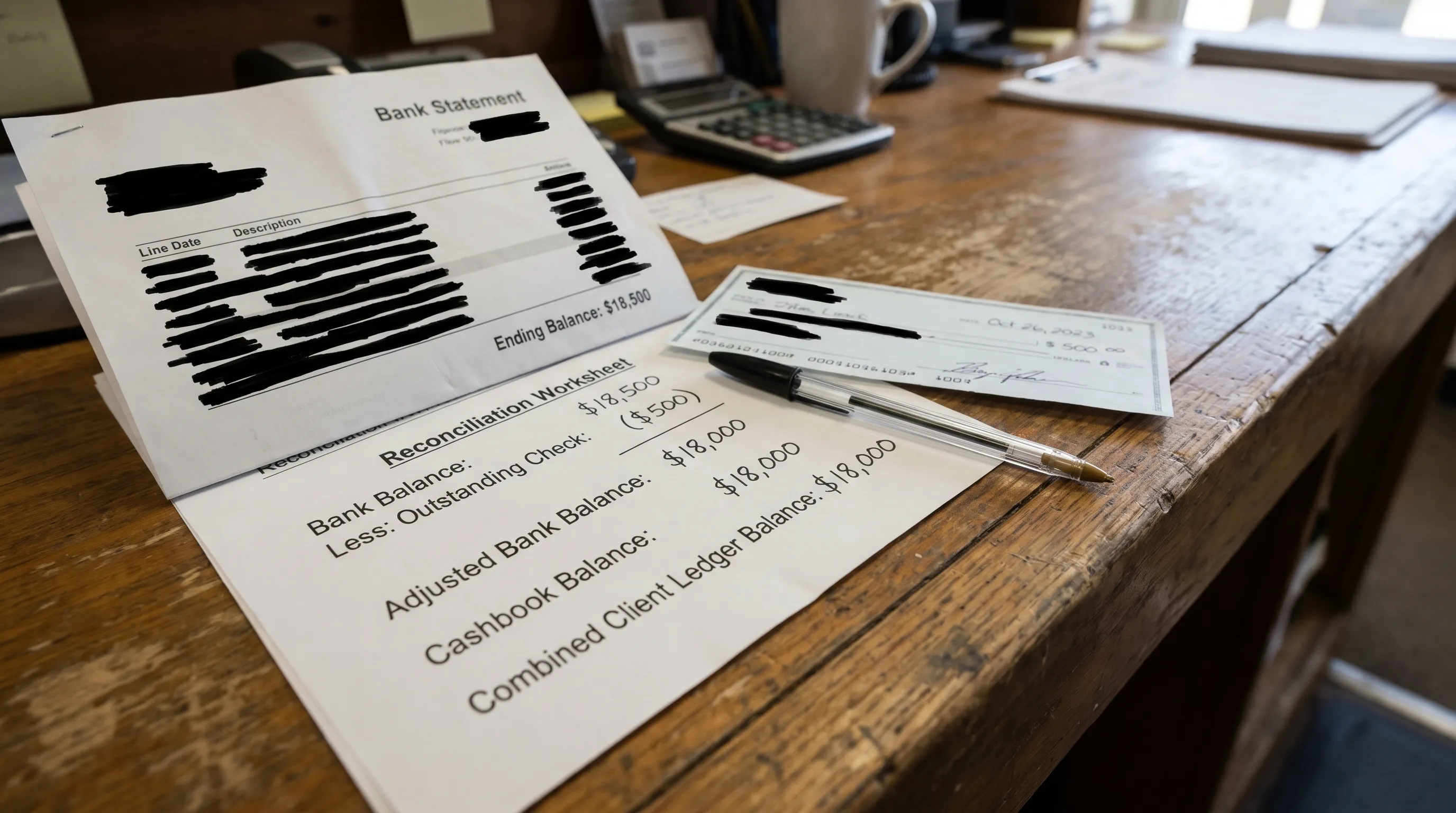
For a pooled client account, trust account statements are one part of a three-way reconciliation. The comparison brings together the adjusted bank balance, the cashbook or account control balance and the total of individual client ledger balances.
Adjust for documented timing differences
Start with the bank statement’s closing balance. Identify deposits recorded in the books but not yet credited by the bank, plus issued payments that have not cleared. Investigate bank-only entries such as charges, interest, returned deposits or corrections.
Using the example above, suppose a further $500 check for Client A was issued and recorded on June 30 but had not cleared. The bank would still show $18,500, while the cashbook would show $18,000. Subtracting the documented outstanding check gives an adjusted bank balance of $18,000.
Do not alter the original bank statement to make it match the books. Keep the adjustment on a separate reconciliation schedule.
Compare the adjusted balance with client records
In that extended example, Client A’s ledger would show $11,500 and Client B’s $6,500. Together they total $18,000, matching both the cashbook and adjusted bank balance.
When trust account statements and ledgers disagree, record the difference as an exception with an owner and supporting evidence. Do not force agreement through an unexplained adjustment. A stale outstanding check, duplicate entry or incorrect client allocation needs resolution, not merely a balancing figure.
Even when all three totals match, inspect individual ledgers for negative balances and review unusual transfers. Agreement at the account level does not validate every allocation.
Keep evidence that explains the numbers
A reliable record set lets another reviewer follow a transaction from the bank entry to the client ledger, then to the reason and authority for the payment. Retain the original statement alongside deposit records, payment confirmations, relevant instructions and reconciliation workpapers.
When preparing trust account statements for review, preserve a clear distinction between original bank data and internal classifications. A client identifier added during bookkeeping is not information supplied or confirmed by the bank.
Extract data without losing its context
PDF conversion can reduce manual entry, especially for lengthy statements or scans. Before importing the results, check that all statement pages and accounts are present. Then review dates, debit and credit signs, transaction references and opening and closing balances. A structured balance-verification process before reporting helps keep conversion checks separate from ledger reconciliation.
For multiple currencies, reconcile each account in its original currency first. If a consolidated report uses exchange rates, document the rate source, date and treatment of translation differences.
Share evidence without exposing other clients
A client asking how funds are protected may need an explanation of controls, not unrestricted access to a pooled bank statement. For firms answering customer due diligence questionnaires, consistent, evidence-linked descriptions of reconciliation and exception handling are more useful than unsupported assurances. Provide appropriately scoped or redacted evidence rather than another client’s financial details.
Reporting duties depend on the role and jurisdiction
There is no single reporting schedule or universal format for trust account statements. The applicable requirements may come from professional conduct rules, fiduciary law, court orders, the trust instrument or contractual obligations.
For US lawyers, the ABA Model Rule 1.15 on safekeeping property provides a model addressing separate custody, records, notification and accounting. It is not itself the binding rule in every jurisdiction. Check the locally adopted requirements for reconciliation frequency, record retention, permitted charges and treatment of interest.
Trustees administering family or other private trusts face a different reporting framework. Beneficiaries’ rights to information, the required contents of an accounting and reporting intervals can vary. A bank’s monthly statement cycle does not automatically determine how often a trustee must account to beneficiaries.
Separate reporting accuracy from payment authority
Before releasing funds, confirm the relevant client or trust entitlement, applicable approvals and any remaining restrictions. The person preparing the reconciliation should be able to identify unresolved items and escalate them to someone with responsibility for resolving them.
A practical control schedule identifies who prepares records, who reviews reconciliations and who can approve or release payments. Where staffing allows, separate those responsibilities. If one person performs several roles, document the independent review or other controls used to reduce the risk of an unnoticed error.
Common mistakes that hide problems with client funds
The most consequential mistakes often leave the overall bank balance looking plausible. Review trust account statements alongside the allocation records rather than treating a positive closing balance as the final control.
- Treating receipts as business revenue: Client money received into trust is not automatically earned income. Classify it according to the underlying arrangement.
- Using only the combined balance: Review every client ledger, including inactive matters and negative balances.
- Leaving timing items unresolved: Track outstanding payments and deposits across periods, then investigate items that do not clear as expected.
- Replacing records with explanations: Keep documentary support for corrections, transfers and disputed allocations rather than relying on an undocumented conversation.
Another frequent problem is reporting only net movement. “Funds decreased by $1,500” conceals the example’s $5,000 receipt and $6,500 of payments. Separate receipts from disbursements so reviewers can understand the activity, not just its net effect.
Use a consistent cutoff for each reporting period and carry the reconciled closing position into the next opening position. If a later correction changes a client’s balance, preserve the original entry and the correction history. Silent overwriting makes it harder to establish what was known, reported or approved at the time.
Frequently asked questions
What should a statement of account for trust funds include? It should identify the account or trust, reporting period, opening position, receipts, payments and closing position. Supporting schedules may need to explain client allocations, assets, liabilities, investment changes or distributions. The precise requirements depend on the account’s purpose and applicable rules.
Who is responsible for trust account statements and records? The trustee, lawyer or other responsible account holder generally retains the relevant duties, even when bookkeeping is delegated. The bank supplies its account statement; it does not maintain the complete client allocation records or determine whether each payment was authorized.
How often should a trustee provide an accounting to beneficiaries? Check the trust document and governing law, together with any court orders or valid information requests. Do not assume that a monthly bank statement fulfills a trustee’s reporting obligations or that one reporting interval applies to every trust.
How is a trust accounting different from a trust tax return? An accounting explains administration and financial activity to the relevant recipients. A tax return reports information under tax rules. For example, US Form 1041 concerns income tax reporting for estates and trusts; it is not a substitute for a beneficiary accounting or client ledger.
Start with verified bank data
Trust account statements are most useful when their figures are accurate and their limits are understood. Reliable extraction supports the process, but client allocation, authorization and legal compliance still require separate checks.
Extract Bank Statements converts bank statement PDFs, scans and photos into CSV, Excel, OFX or JSON, checking extracted figures against the statement’s running balance and totals before export. Use that verified bank data as the starting point for reconciliation, then connect it to client ledgers and supporting evidence. Free first conversions let you test the workflow with your own statements.