
What Debit and Credit Mean on Your Bank Statement
Thomas Gak-Deluen8 min read
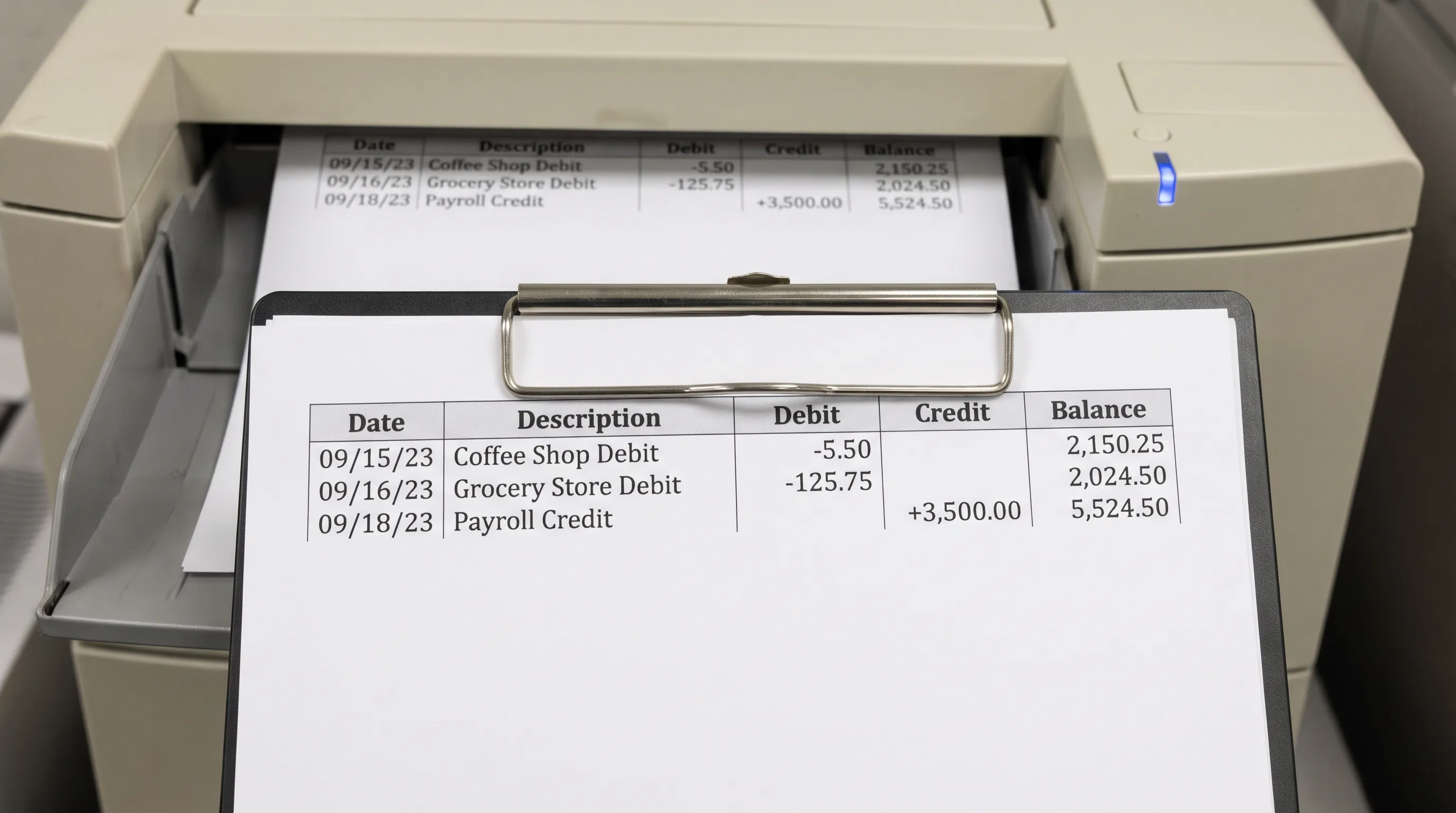
On a checking or savings account, bank statement debit and credit entries reflect the bank’s accounting perspective: a debit reduces your account balance and a credit increases it. A positive deposit balance represents money the bank owes you, which explains why these labels can seem backward if you know bookkeeping.
For everyday reading, start with the direction of the money. A paycheck adds funds, a bill payment removes them and a refund generally adds them back. Then check the description to understand what happened. The label alone cannot tell you whether a transaction is income, an expense or an error.
The basic rule for checking and savings accounts
For an ordinary deposit account, read the transaction columns this way:
| Statement label | Effect on your balance | Common examples |
|---|---|---|
| Debit, withdrawal or money out | Decreases the balance | Purchases, bill payments, ATM withdrawals and fees |
| Credit, deposit or money in | Increases the balance | Paychecks, incoming transfers, refunds and interest earned |
A debit does not necessarily mean you used a debit card. A check, an electronic bill payment or a monthly maintenance fee can also appear as a debit.
Likewise, a credit does not mean you borrowed money or used a credit card. Your employer’s direct deposit is normally a credit because it increases your deposit account balance.
For deposit accounts, bank statement debit and credit labels describe balance changes, not whether a transaction is beneficial. A fee refund is a credit, but so is a loan deposit that creates a repayment obligation elsewhere.
Why your bookkeeping may use the opposite entry
A bank records your positive deposit balance as a liability: it owes that money to you. Crediting that liability increases what it owes you. Debiting it reduces what it owes you.
Your own business books look at the same money differently. Money in the business checking account is an asset, usually recorded in a Cash or Bank account. In double-entry bookkeeping, a debit increases that asset and a credit decreases it.
The same transaction can therefore receive opposite labels without either record being wrong:
| Event | On the bank statement | In the business’s Cash account |
|---|---|---|
| A $600 customer payment arrives | $600 credit | $600 debit |
| An $85 utility payment leaves | $85 debit | $85 credit |
These are two perspectives on the same movement, not two separate payments. Each party also records the other side of its own accounting entry.
This is why bank statement debit and credit terminology should not be copied directly into a business’s cash ledger. First identify whether cash increased or decreased, then apply the bookkeeping rules for the accounts involved.
Follow a deposit and withdrawal through the balance
Suppose a checking account starts with $1,000. During the statement period, it receives a customer payment, pays a utility bill and incurs a bank fee.
| Transaction | Debit | Credit | Running balance |
|---|---|---|---|
| Opening balance | $1,000.00 | ||
| Customer payment | $600.00 | $1,600.00 | |
| Utility payment | $85.00 | $1,515.00 | |
| Account maintenance fee | $5.00 | $1,510.00 |
The calculation is:
Opening balance + credits − debits = closing balance
Here, that means $1,000 + $600 − $90 = $1,510.
Notice that the fee is a debit even though nobody swiped a card. Also, the statement shows that $600 arrived, but it does not establish whether that payment represents a new sale, settlement of an earlier invoice or something else.
The running balance provides another way to interpret an unclear row. If the posted balance changes from $1,600 to $1,515 after an $85 transaction, that entry reduced the account by $85. Check the statement’s transaction order before using this method, since some statements list the newest entries first.
Reading bank statement debit and credit labels
Banks do not all use identical layouts. Some provide separate debit and credit columns. Others use one amount column with positive and negative numbers, parentheses or abbreviations such as DR and CR.
In a transaction column, DR generally identifies a debit and CR generally identifies a credit. Beside a balance, however, DR may indicate an overdrawn deposit account. Check the statement legend or ask the bank if the placement makes the meaning unclear.
Descriptions also need context. “Debit adjustment” may correct an earlier entry rather than represent a purchase. A returned deposit can reduce your balance even though the original deposit was a credit. A reversed purchase may create a credit that offsets an earlier debit.
Read the label, description and balance movement together. Do not interpret a word such as “return” or “reversal” without checking which way the amount moved.
Finally, posted transactions and pending authorizations are different. A temporary card hold may affect the money available to spend without appearing as a completed debit on that period’s statement.
ACH debits and credits: the payment instruction matters
ACH is an electronic payment network used for transactions such as payroll and recurring bills. The account effect follows the same rule as other entries.
For ACH payments, bank statement debit and credit labels tell you whether the posted transaction reduced or increased your balance. The distinction also describes how the payment was initiated.
An ACH credit is generally a payment pushed by the sender, such as an employer sending payroll to your account. An ACH debit is generally a payment pulled by a biller or another authorized party, such as a utility collecting a scheduled payment.
The word “authorized” matters: an ACH debit label does not itself prove that you approved the withdrawal. Compare unfamiliar payments with your payment agreements and records.
An ACH return or reversal can produce a separate entry in the opposite direction. Review both entries before treating the second one as new income or a new expense.
Credit card statements use a different balance
A bank account statement normally tracks money held in your deposit account. A credit card statement tracks a borrowing balance, usually the amount you owe the card issuer.
On a credit card statement, purchases, interest and fees generally increase the amount owed. Payments, refunds and other credits generally reduce it. That is why a “credit” on a card statement can be welcome without representing a deposit into your checking account.
A card payment creates two related effects: a debit leaves your checking account and a payment credit reduces your credit card balance. They are records of the same payment on different accounts.
If you are reviewing borrowing rather than deposits, the guide to credit card statement terms that affect what you owe explains the balances and payment terms to check.
Money in is not always income, and money out is not always an expense
The direction of a transaction is only the first classification step. Moving $500 from your savings account to your checking account creates a debit in savings and a credit in checking. It does not create $500 of new income.
Similarly, loan proceeds increase cash but generally create a liability. A loan payment reduces cash, but its principal and interest components may require different accounting treatment.
For a business expense, the supporting document matters too. Suppose a fitness brand pays a sports marketing agency such as OPTYO. The outgoing payment appears as a debit, but the invoice and service details establish what the business purchased and how it should be recorded.
The same principle applies to refunds, owner contributions and reimbursements. Use bank statement debit and credit entries to establish the direction and amount of the cash movement, then use invoices, agreements or other records to establish its purpose. A transaction description alone is not a complete accounting record.
Check the arithmetic before using the figures
Start with the opening balance, add the period’s credits and subtract its debits. The result should match the closing balance when all posted entries are included and the statement uses the ordinary deposit-account convention.
If it does not, check for missing pages, omitted fees, duplicate rows or an amount assigned to the wrong column. When working in a spreadsheet, choose either separate debit and credit columns or one signed amount column, then apply that convention consistently. Subtracting an already-negative debit can accidentally turn it into an addition.
Checking bank statement debit and credit totals is useful, but it has limits. A fraudulent payment can still fit the balance calculation perfectly, and two extraction errors can sometimes offset each other.
Understanding what bank statement reconciliation can and cannot prove helps keep arithmetic checks separate from transaction verification. Matching totals supports the numbers, not the legitimacy or accounting category of every payment.
What to do with an unfamiliar debit or credit
Compare the amount, posting date and reference with receipts, payment confirmations and transfers between your accounts. A merchant’s statement descriptor may differ from its storefront name, but do not assume that explains an entry you cannot verify.
Contact the bank promptly about suspected unauthorized activity or errors. An unfamiliar credit also deserves investigation, particularly if someone asks you to send the money elsewhere.
For covered electronic transfers, Regulation E’s error-resolution rules generally require notice within 60 days after the bank sends the statement first showing the error. Other notice and liability rules can apply, so report concerns immediately rather than treating that period as a reason to wait.
Frequently asked questions
Does a debit always mean a debit card purchase? No. Checks, ATM withdrawals, account fees and electronic payments can all reduce a deposit account balance and appear as debits.
Can a credit be reversed later? Yes. A returned payment, correction or reversal may remove an earlier credit. Review the related entries and ask the bank if the reason is unclear.
Do bank statement debit and credit labels show taxable income and deductible expenses? No. They show account movements. Tax and bookkeeping treatment depend on the underlying transaction, not just its direction.
Does a credit balance mean the same thing on every statement? No. On a deposit account it generally means funds held for you. On a credit card account, a credit balance generally means payments and credits exceed the amount owed. Confirm the account type and statement legend.
Turn statement entries into usable spreadsheet data
Extract Bank Statements converts statement PDFs into CSV or Excel and verifies extracted figures against the statement’s running balance and declared totals before export. It also supports scans and photos through OCR.
Use those checks to validate the extracted numbers, then review descriptions and supporting records to establish what each debit or credit means.