Billing Statement vs. Invoice vs. Bank Statement
Thomas Gak-Deluen9 min read

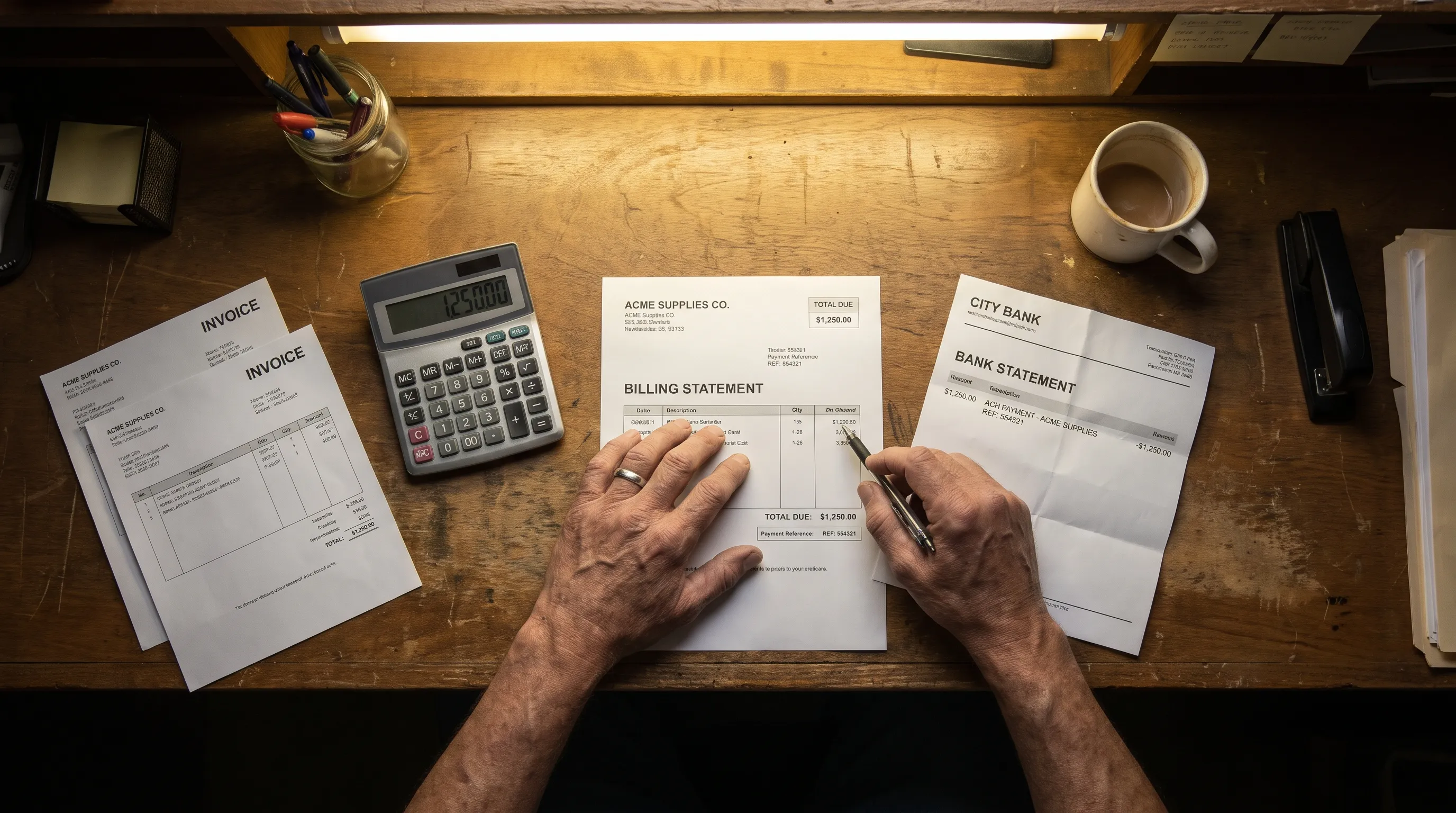
A billing statement summarizes activity and the balance on an account over a period. An invoice requests payment for specific goods or services. A bank statement records transactions posted to a bank account. They can describe different stages of the same purchase, but they are not interchangeable evidence.
That distinction matters when you are deciding what to pay, checking whether a payment went through or entering expenses into accounting software. Treating all three documents as separate charges can lead to duplicate payments and overstated expenses.
The difference at a glance
| Document | Who usually issues it | Main purpose | What it does not establish by itself |
|---|---|---|---|
| Billing statement | A supplier, service provider or credit card issuer | Summarize account activity, adjustments and amounts owed for a period | That every listed charge is correct or still unpaid today |
| Invoice | A seller or service provider | Request payment for a particular sale, delivery or service period | That the customer has paid |
| Bank statement | A bank or credit union | Record posted deposits, withdrawals, fees and account balances | What was purchased or how a supplier allocated a payment |
An invoice is usually transaction-specific. An account summary may bring several invoices, payments and credits together. A bank record shows the movement of money, which may occur days or weeks after the original purchase.
A billing statement can also serve as a payment request, particularly for credit cards and utilities. Do not assume that the word “statement” means no action is required. Check the amount due, due date and payment instructions.
These categories can overlap. A credit card statement is both an account activity record and a payment request. Here, “bank statement” primarily means a checking or savings account statement, rather than a credit card statement issued by a bank.
What a billing statement includes
A useful account summary typically identifies the customer and account, then explains how the closing balance was calculated. Common fields include:
- The statement period and closing date
- The previous balance
- New charges, invoice references and fees
- Payments, refunds and credits applied during the period
- The closing balance, amount due and payment deadline
- Contact details for billing questions or disputes
Not every provider uses the same layout. Some show individual transactions; others show invoice totals with a separate aging summary for overdue amounts.
An invoice, by comparison, usually includes an invoice number, issue date, description of goods or services, prices, taxes and payment terms. It may cover a single purchase or recurring services for a month. An invoice date is not necessarily the payment deadline.
A bank statement normally identifies the account and reporting period, then lists posted transactions and opening and closing balances. Transaction descriptions can help identify a payee, but often do not provide enough detail to classify a purchase correctly without the underlying invoice or receipt.
For a billing statement, the key question is how the provider arrived at the amount owed. For an invoice, it is what the charge covers. For a bank record, it is whether and when money moved.
Statement balance, current balance and amount due
These figures answer different questions, even when they appear on the same screen.
Statement balance and current balance
The statement balance is a snapshot at the end of a billing cycle. It generally does not change when later transactions occur, although a provider may issue a corrected document.
The current balance reflects more recent posted activity. Payments or credits after the closing date can reduce it, while new purchases can increase it. Pending transactions are often excluded from the posted balance, though they may affect available credit or available funds.
For example, a credit card might close with an $800 balance. A $300 payment posted afterward would reduce that balance to $500 if nothing else had posted. The original document would still show $800.
Amount due and minimum payment
The amount due is the payment requested under the account’s terms. It may differ from the closing balance because of installments, earlier payments, overdue amounts or other adjustments.
For credit cards, the minimum payment is not the same as the full statement balance. Paying only the minimum generally does not avoid interest. Grace periods and interest treatment depend on the card agreement and transaction type.
A billing statement should therefore be read alongside any later posted payments. Before paying, check whether a recent payment has already reduced the remaining obligation and whether autopay is scheduled.
Closing date and due date
The closing date ends the billing cycle. The due date is the deadline for the requested payment. Confusing them can cause a late payment or make a recent charge appear to be missing when it belongs to the next cycle.
How the documents differ across common situations
Credit cards and utilities
A credit card account summary typically combines purchases, payments, interest, fees and a minimum payment requirement. A utility document may function as both a detailed bill for the latest service period and a summary of any earlier unpaid balance.
In either case, check service dates and previous payments before assuming the entire displayed balance represents new spending.
Healthcare and insurance
A healthcare billing statement may show provider charges, insurance payments, contractual adjustments and the patient’s remaining responsibility. That amount can change while a claim is being processed.
An insurer’s explanation of benefits, or EOB, is not a bill. Compare its claim details with the provider’s bill. If insurance processing is incomplete or the patient responsibility differs, ask the provider and insurer to explain the discrepancy rather than assuming either document is final.
Subscriptions and business services
A subscription provider may issue an invoice for each renewal and maintain an account history showing credits and payments. Business suppliers often send monthly summaries covering several invoices.
Advertising adds another distinction: platform spending and an agency’s management fee may be separate obligations. This illustration of a campaign billing screen alongside a platform invoice shows the kind of records that can appear in that workflow. Confirm whether the agency pays the platform and recharges the client or whether the platform bills the client directly before recording both amounts as separate expenses.
A worked example: one supplier, three kinds of evidence
Suppose a supplier sends an October billing statement containing the following activity. These figures are illustrative, not a required document format.
| Account activity | Amount |
|---|---|
| Previous unpaid balance | $300 |
| New invoice A | $500 |
| New invoice B | $200 |
| Payment credited during October | -$400 |
| Credit note | -$50 |
| Closing balance | $550 |
The arithmetic is:
$300 + $500 + $200 - $400 - $50 = $550.
Invoice A and invoice B explain the two new charges. The monthly summary explains how those charges combine with earlier activity. A corresponding $400 debit on the customer’s bank statement supports the cash movement associated with the payment.
However, the bank debit alone does not show which invoices the supplier settled. Payment allocation may require a remittance advice or confirmation from the supplier.
Do not enter another $550 expense just because the supplier sent an account summary. If the underlying invoices are already recorded, doing so would duplicate the liability. Whether the supplier expects all $550 immediately depends on the payment terms and due dates, not just the closing total.
Match the records before paying or posting
Start with the invoice number, supplier identity, currency and amount. Then check whether the charge appears in the supplier’s account activity and whether a related payment appears in the bank records.
A billing statement is especially useful for identifying missing invoices, unapplied payments or credit notes that have not reached your accounting records. It is a reconciliation document, not automatically a new transaction to book.
Match amounts carefully. One bank payment may settle several invoices, and one invoice may be paid in installments. Processing dates can also differ between the bank and supplier. Foreign exchange and payment fees can create legitimate differences that need separate explanation.
For the cash side of the comparison, use a consistent process to read a bank statement and verify each transaction. Keep the original PDFs and record the reference connecting each invoice, adjustment and payment.
A balance that adds up is not proof that every charge is valid. Arithmetic checks do not establish authorization, correct tax treatment or whether a supplier delivered what was purchased.
How to challenge an incorrect charge
An incorrect billing statement needs a documented explanation, not just a verbal assurance that someone will investigate. Identify the specific line, amount and reason for your concern before contacting the issuer.
For an ordinary supplier discrepancy, provide the invoice reference and supporting evidence, such as a credit note, payment confirmation or cancellation acknowledgment. Ask whether the issue is a duplicate charge, an unapplied payment, a missing adjustment or a timing difference.
Keep a dated record of your request, the case number and any promised correction. Ask for written confirmation or a revised document, then check that the adjustment appears in the account. Do not assume that opening a dispute automatically pauses collection or changes payment terms.
For US consumer credit cards, formal billing-error protections have specific requirements. The Consumer Financial Protection Bureau explains the credit card dispute process, including sending a written billing-error notice within 60 days after the issuer sent the first statement containing the error. Follow the issuer’s billing-inquiries instructions and continue paying undisputed amounts as required.
Report suspected unauthorized activity to the financial institution promptly. Debit card and bank account protections differ from credit card rules, so do not apply the same deadline to every account type.
Handle financial documents securely
Invoices and account summaries can contain addresses, account identifiers, payment instructions and, in healthcare, sensitive treatment information. Download documents through a trusted portal when available and limit access to people who need them.
Verify changed bank details through a known contact channel before paying. An email containing a familiar invoice number is not sufficient proof that new payment instructions are genuine.
When sharing documents for bookkeeping or a dispute, redact unnecessary information without removing the details needed to investigate. Keep unaltered originals in controlled storage and follow applicable retention requirements.
Frequently asked questions
Is a bill the same as an invoice? Often, yes. “Bill” is the everyday term for a payment request, while businesses commonly use “invoice.” The document’s contents and payment terms matter more than its label.
Can I use a billing statement instead of an invoice? It may help establish the account balance, but it may lack purchase details or tax information. For bookkeeping, reimbursement or tax support, obtain the underlying invoice when required by the relevant policy or rules.
Does a bank statement prove an invoice was paid? A matching posted transaction supports payment, but may not establish how the recipient allocated it. Use the payment reference, remittance details or supplier confirmation to connect the records.
Why does my balance differ from the amount on the statement? Later payments, new posted charges, refunds or adjustments can change the current balance after the closing date. Pending items may be displayed separately. Compare dates and posting status before treating the difference as an error.
Turn bank records into usable reconciliation data
When comparing a billing statement with actual payments, structured bank data can reduce manual copying. Extract Bank Statements converts bank statement PDFs, scans and photos into formats including CSV and Excel, checking extracted figures against the statement’s running balances and totals before export.
Those checks help validate extraction, but they do not prove that a supplier charge was authorized or correctly allocated. Keep the invoice and account summary alongside the bank data so each part of the transaction has supporting evidence.